
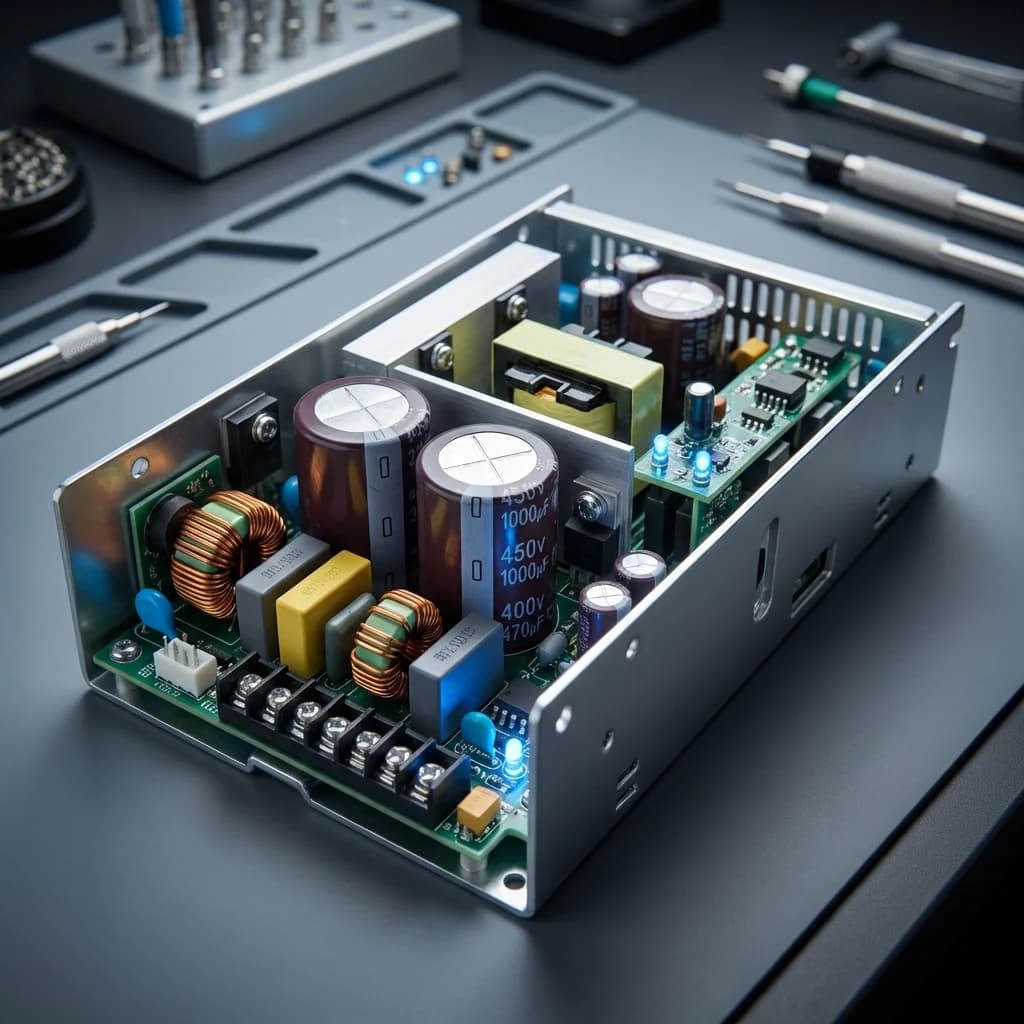
Consumer Electronics Capacitors
Overview
Technical Advantages
Miniature sizes for portable devices
Cost-effective for volume production
Audio-grade options for Hi-Fi
RoHS and REACH compliant
Wide availability for design flexibility
Consumer Electronics Capacitor Applications
Consumer electronics drive innovation in capacitor miniaturization and cost reduction. High-volume production demands create economies of scale while competitive pressures push continuous improvement in size, performance, and reliability. A modern smartphone contains 800-1,000 capacitors; a gaming console or laptop contains 2,000-4,000. The consumer electronics sector consumes more MLCC (multilayer ceramic capacitors) than any other industry. Specap supplies capacitors for consumer electronics manufacturers, contract electronics manufacturers (CEMs), repair shops, and hobbyist builders. From ultra-miniature 01005 MLCC for smartphones to large electrolytic capacitors for home theater amplifiers, our inventory covers the full range of consumer electronics capacitor needs. #
Smartphone and Tablet MLCC Requirements
Modern smartphones and tablets are the most capacitor-dense consumer devices, driven by relentless miniaturization and increasing functionality: - **Ultra-Miniature Packages**: Flagship smartphones use 0201 (0.6mm x 0.3mm) and 01005 (0.4mm x 0.2mm) MLCC as standard, with 008004 (0.25mm x 0.125mm) emerging in the most space-constrained areas. These tiny components are placed by advanced pick-and-place machines with ±25µm accuracy. - **High-Capacitance MLCC**: Power management ICs in smartphones require decoupling capacitors with high capacitance in small packages — 10µF in 0402 (1.0mm x 0.5mm) package is now standard. X5R and X7R dielectrics provide the necessary capacitance density, though engineers must account for DC bias derating (capacitance drops 30-60% at rated voltage for high-K dielectrics). - **RF Front End**: 5G smartphones contain complex RF front-end modules with dozens of filters, switches, and amplifiers. Each requires precisely specified MLCC for impedance matching, DC blocking, and bias decoupling. C0G/NP0 dielectric capacitors maintain stable capacitance across temperature and voltage for critical RF circuits. - **Camera and Display**: OIS (optical image stabilization) actuators, LED flash drivers, and OLED display driver power supplies use specialized capacitors for their unique voltage and current requirements. #
Computing Devices
Laptops, tablets, and desktop computers use thousands of capacitors: - **Processor Power Delivery**: Modern CPUs and GPUs demand 100-300A of current with sub-nanosecond transient response. Arrays of low-ESR capacitors — including bulk MLCC (100µF+ in 1210 packages), aluminum polymer capacitors, and tantalum polymer capacitors — form the multi-tier power delivery network. Each tier handles a different frequency band of the processor current demand. - **Memory Decoupling**: DDR5 memory operates at data rates up to 6400MT/s, requiring MLCC bypass capacitors placed within millimeters of memory IC power pins for signal integrity. C0G capacitors are used for VTT termination voltage reference circuits where capacitance stability is critical. - **Storage Systems**: NVMe SSD controllers, NAND flash power supplies, and high-speed PCIe interface circuits require bypass capacitors. Enterprise SSDs also use tantalum or large MLCC capacitors for power-loss protection — storing enough energy to flush volatile cache to NAND during unexpected power loss. - **USB-C Power Delivery**: USB-C PD chargers and laptop docking stations support up to 240W (48V, 5A) per the USB PD 3.1 specification. The AC/DC converter inside a USB-C PD charger uses input filter capacitors (X and Y safety types), PFC boost capacitors, primary-side bulk electrolytic capacitors, and output ceramic and polymer capacitors. GaN-based USB-C chargers operate at higher switching frequencies (200kHz-1MHz), enabling smaller capacitors but requiring lower-ESL types for effective filtering. #
Gaming Consoles and PC Power Supplies
Gaming systems push power delivery to extremes with high-performance processors and GPUs: - **Console Power Supply Units**: Gaming consoles (PlayStation, Xbox, Nintendo Switch) use compact internal power supplies that convert AC mains to multiple DC rails. These PSUs contain input EMI filter capacitors, PFC stage capacitors, primary bulk electrolytic capacitors, and output polymer and ceramic capacitors. Reliability is critical — console PSU failures generate significant warranty costs. - **PC Power Supply (ATX)**: Desktop gaming PCs use ATX power supplies rated from 500W to 1600W+. Quality PSU manufacturers (Corsair, Seasonic, EVGA) specify Japanese-brand electrolytic capacitors (Nichicon, Rubycon, Nippon Chemi-Con) for the primary and secondary stages. The primary DC bus uses 400V-rated electrolytic capacitors, while output stages use a mix of electrolytic and polymer capacitors. - **GPU Power Delivery**: High-end graphics cards draw 200-450W through multi-phase VRM circuits. The VRM uses MLCC arrays (dozens of 22µF-100µF capacitors in 0805/1206 packages) and aluminum polymer capacitors for clean, fast power delivery to the GPU die. Insufficient or low-quality capacitors cause voltage droop, instability, and crashes under gaming loads. - **Gaming Peripherals**: Mechanical keyboards, gaming mice, and headsets use capacitors for debouncing, power filtering, and audio circuits. Low-profile MLCC and small electrolytic capacitors in these peripherals must survive millions of use cycles. #
Wearable Device Capacitor Constraints
Smartwatches, fitness trackers, hearables (TWS earbuds), and AR/VR headsets impose the most extreme size constraints on capacitors: - **Ultra-Small, Low-Profile**: Wearable PCBs use 0201 and 01005 MLCC almost exclusively, with component heights limited to 0.3mm or less for slim watch designs. Low-profile (0.15mm height) MLCC are available for the thinnest wearable designs. - **Low Leakage for Battery Life**: Wearable devices run on tiny batteries (100-500mAh). Capacitor leakage current — even at nanoampere levels — directly affects standby battery life. Low-leakage MLCC and tantalum capacitors are specified for always-on sensor circuits and real-time clock backup. - **Flex-Compatible Capacitors**: Some wearable designs use flexible PCBs that bend during normal wear. Flexible termination MLCC (with polymer-based terminations instead of rigid solder) resist cracking when the PCB flexes, preventing the catastrophic short-circuit failures that rigid-termination MLCC can exhibit on flex circuits. #
Home Appliances
Household appliances contain capacitors throughout: - **Motor Starting**: Motor start and run capacitors for compressors, fans, and pumps in refrigerators, washing machines, and dishwashers - **LED Lighting**: Driver capacitors for efficient LED operation — electrolytic capacitors in LED drivers are the primary life-limiting component - **Power Supplies**: Input and output filtering for switch-mode supplies in smart home devices, routers, and set-top boxes - **Control Boards**: Microcontroller bypass and timing capacitors for appliance control electronics - **Induction Cooktops**: High-frequency resonant capacitors for induction heating coils operating at 20-50kHz #
Audio Equipment
Hi-Fi audio and professional sound equipment have specific capacitor requirements: - **Coupling Capacitors**: Film capacitors in signal paths must have low distortion and minimal dielectric absorption. Polypropylene film capacitors are the standard choice for transparent sound. - **Power Supply Filtering**: Large electrolytic capacitors for amplifier power supplies — Nichicon KG, MUSE, and Rubycon MCZ series are popular choices among audiophiles and professional equipment manufacturers. - **Crossover Networks**: Precision polypropylene film capacitors for speaker crossover filters, with tight tolerances (±5% or better) for accurate frequency division. - **Digital Audio**: Low-jitter timing circuits in DACs and digital transports require C0G ceramic capacitors with stable capacitance for PLL and crystal oscillator load circuits.
Case Studies & Success Stories
Gaming Console Power Supply Redesign
The Challenge
Capacitor plague failures in early production runs caused widespread warranty returns — electrolyte formulation issue in budget capacitors.
The Solution
Qualified Specap-sourced Nichicon and Rubycon premium electrolytic capacitors with verified electrolyte formulations and full traceability.
The Result
Reduced field failure rate from 4.2% to under 0.1% within 6 months, saving an estimated $2.8M in warranty costs annually.
Gaming Peripheral GPU VRM Capacitor Upgrade
The Challenge
High-end GPU cards experiencing VRM instability and crashes under sustained gaming loads due to insufficient output capacitance and excessive ESR in the multi-phase power delivery circuit, resulting in voltage droop exceeding GPU specifications.
The Solution
Specap supplied high-capacitance (100µF) low-ESR aluminum polymer capacitors and high-density MLCC arrays (22µF X5R in 0805 packages) from Murata and Panasonic, enabling a redesigned 16-phase VRM with 40% lower output impedance across the critical 100kHz-10MHz frequency range.
The Result
Eliminated GPU crash reports under sustained load, achieved 15mV tighter voltage regulation under full load, and enabled a 5% higher boost clock ceiling — contributing to a "Best Performance" award from a major hardware review publication.
Capacitor Types Explained
Overview of all capacitor types used in consumer electronics
Read guideComplete Guide to Electrolytic Capacitors
Selection, lifecycle, and replacement guide for electrolytic capacitors
Read guideUnderstanding Capacitor Markings
Decode capacitor value codes, voltage ratings, and date codes
Read guide