
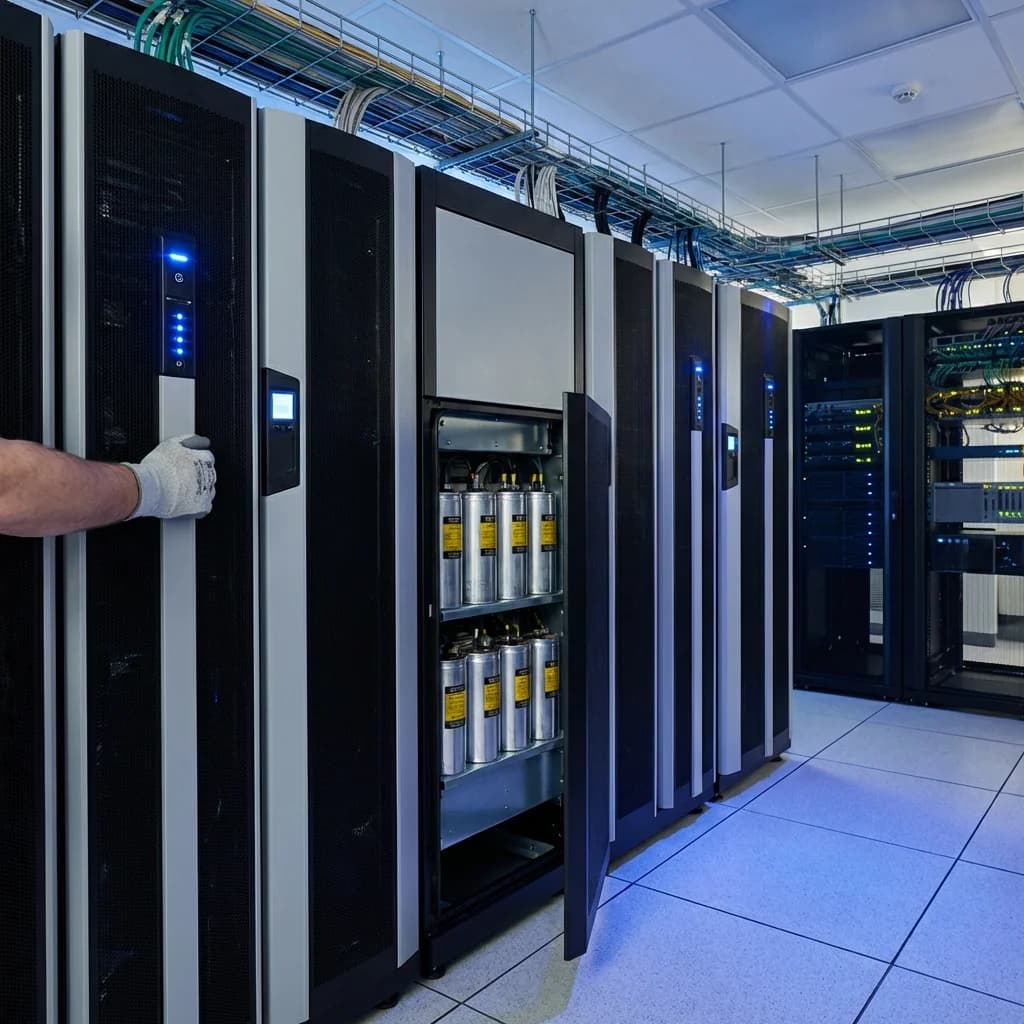
Power Electronics Capacitors
Overview
Technical Advantages
High ripple current handling capacity
Low ESR and ESL for efficient operation
Self-healing film dielectric options
Compact designs for power density
Long service life under demanding conditions
Power Electronics Capacitor Applications
Power electronics converts electrical energy from one form to another — AC to DC, DC to AC, or changing voltage and frequency levels. Capacitors are essential components in every power conversion topology, serving functions from energy storage to filtering and protection. #
DC Link Capacitors
The DC link is the heart of most power converters, connecting the rectifier stage to the inverter stage. DC link capacitors serve critical functions: - **Energy Storage**: Buffering energy between stages operating at different instantaneous power levels - **Voltage Stabilization**: Maintaining stable DC bus voltage during load transients - **Ripple Current Handling**: Absorbing the high-frequency current components from switching [Film capacitors](/capacitors/film) are increasingly preferred for DC links due to their high ripple current capability, long life, and self-healing properties. Aluminum electrolytic capacitors remain common where high capacitance per volume is required. Leading DC link capacitor manufacturers include [EPCOS/TDK](/epcos-capacitors), [Cornell Dubilier](/brands/cde), [Vishay](/vishay-capacitors), and KEMET. #
Snubber Capacitors
Snubber circuits protect power semiconductors (IGBTs, MOSFETs, thyristors) by controlling voltage rise rates during switching. Snubber capacitors must handle: - Very high dv/dt stress, often exceeding 1000V/µs - High peak currents during turn-off events - Elevated operating temperatures from absorbed energy Polypropylene film capacitors are the standard choice for snubber applications due to their low losses, high pulse current capability, and stability. #
Capacitor Selection by Power Topology
Different converter topologies place different demands on capacitors. Understanding which topology your equipment uses helps identify the right capacitor: - **Buck (Step-Down) Converter** — Output capacitors must handle high ripple current from the inductor charging cycle. Low ESR is critical for output voltage regulation. Polymer aluminum or multi-layer ceramic capacitors are preferred for low-power stages. - **Boost (Step-Up) Converter** — Input capacitors see continuous current while output capacitors handle pulsed current. The output capacitor must withstand high voltage stress (often 400-800V DC for PFC stages). Film capacitors excel here. - **Full-Bridge / H-Bridge Inverter** — The DC link capacitor bank must supply the full inverter current during switching transitions. Ripple current calculation must account for all switching harmonics. See our [film capacitor selection guide](/resources/guides/film-capacitor-selection) for sizing guidance. - **Resonant Converters (LLC, DAB)** — Resonant capacitors operate at the switching frequency and must handle high AC current without significant heating. Low-loss polypropylene film or C0G ceramic types are required. Capacitance stability is critical for maintaining resonant frequency. - **Active Front End (AFE) / Vienna Rectifier** — These PFC topologies use AC filter capacitors on the input and DC link capacitors on the output. The input filter capacitors must carry high-frequency PWM current while meeting safety standards. #
UPS Systems
Uninterruptible power supplies require capacitors throughout: - **Input filtering**: [EMC compliance](/resources/blog/emi-emc-filter-capacitor-selection-guide) and power factor correction - **DC bus**: Energy storage for ride-through capability — typically large screw-terminal aluminum electrolytics or film capacitors - **Output filtering**: Clean sine wave generation using LC filter stages - **Battery charger stage**: Filtering and decoupling in the bidirectional converter UPS capacitors must be highly reliable since the equipment is typically protecting critical loads like data centers, hospital systems, and financial trading infrastructure. Scheduled capacitor replacement every 5-7 years is standard practice for mission-critical UPS installations. #
Solar Inverters
Photovoltaic inverters convert DC from solar panels to grid-compatible AC: - **DC link capacitors**: Handle variable power from changing irradiance. String inverter DC links typically operate at 600-1000V DC, while central inverters may reach 1500V DC. Film capacitors are strongly preferred for their 25+ year life expectancy matching the solar panel warranty. - **EMI filter capacitors**: Meet grid connection requirements including IEEE 1547 and IEC 62109 safety standards. - **MPPT stage capacitors**: Maximum power point tracking converters use capacitors in the boost or buck stage that must handle wide voltage ranges as panel output varies throughout the day. Long life is essential as [solar and renewable energy installations](/applications/renewable-energy) are expected to operate 25+ years with minimal maintenance. #
Energy Storage Systems (ESS)
Battery energy storage systems use power electronics for charging and discharging: - **Bidirectional converter capacitors** for charge/discharge cycles — must handle full power flow in both directions - **Grid-tie filter capacitors** for interconnection compliance with utility standards - **High-energy capacitors** for power quality applications including frequency regulation and peak shaving - **Supercapacitor banks** — [Eaton](/eaton-capacitors) and Maxwell supercapacitors provide fast energy delivery for grid stabilization and regenerative braking energy recovery #
SiC and GaN: Impact on Capacitor Selection
The adoption of wide-bandgap semiconductors (silicon carbide and gallium nitride) is reshaping capacitor requirements in power electronics: - **Higher switching frequencies** (100kHz-1MHz vs 10-50kHz for silicon) mean capacitors see higher-frequency ripple current. ESR and ESL at these frequencies become more important than bulk capacitance. - **Faster switching transitions** (dv/dt of 5,000-50,000 V/µs for SiC vs 1,000-5,000 V/µs for IGBTs) place more stress on snubber capacitors and require lower parasitic inductance in the DC link. - **Higher DC bus voltages** — SiC devices enable operation at 800V, 1200V, and even 1700V DC bus voltages, requiring capacitors with higher voltage ratings and adequate [derating margins](/resources/guides/capacitor-derating). - **Smaller passive components** — Higher frequencies allow smaller inductors and capacitors, but the capacitors must still handle the thermal load from higher-frequency losses. Low-loss film capacitors and C0G MLCC are the primary choices. #
Thermal Management & Reliability
Capacitor life in power electronics is fundamentally governed by thermal stress. Key considerations include: - **Ambient temperature** — Every 10°C reduction in operating temperature approximately doubles electrolytic capacitor life. Film capacitors are less sensitive but still benefit from thermal management. - **Self-heating from ripple current** — High ripple current causes internal heating proportional to I²×ESR. This temperature rise adds to the ambient temperature to determine actual capacitor core temperature. - **Mounting orientation and airflow** — Screw-terminal electrolytics should be mounted vertically with the vent facing up. Adequate airflow across the capacitor body can reduce core temperature by 5-15°C. - **MTBF calculations** — For mission-critical power electronics (medical, [aerospace](/applications/aerospace), data center), capacitor MTBF should be calculated based on actual operating conditions, not catalogue ratings. Our engineering team can assist with reliability analysis. #
Why Choose Specap for Power Electronics Capacitors?
We supply capacitors for power electronics applications ranging from 100W bench supplies to multi-megawatt industrial converters. Our strengths include sourcing from [all major capacitor manufacturers](/capacitor-supplier), stocking both current-production and [obsolete replacement parts](/obsolete-capacitors), and providing technical support for capacitor selection and cross-referencing. Every part ships with full [electrical testing and quality verification](/quality).
Case Studies & Success Stories
Solar Inverter DC Link Reliability
The Challenge
Electrolytic DC link capacitors in 100kW string inverters failing after 3-4 years in desert installations due to thermal stress.
The Solution
Redesigned with Specap-sourced polypropylene film DC link capacitors rated for 105°C with 100,000-hour life expectancy.
The Result
Achieved 5+ years of zero-failure operation across 200+ installed inverters, reducing warranty costs by 85%.