
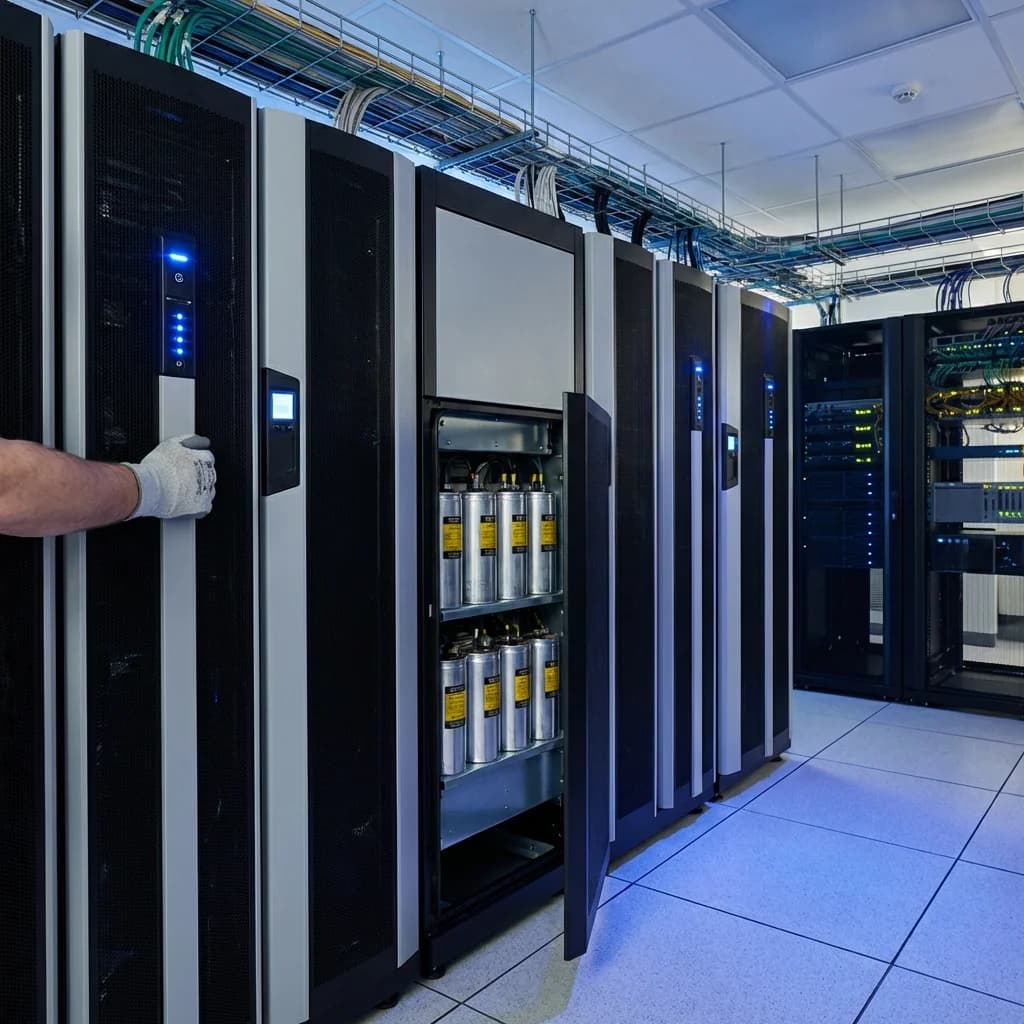
UPS Capacitors — Uninterruptible Power Supply Capacitor Replacement
Overview
Technical Advantages
Ultra-high reliability for mission-critical uptime
Self-healing technology for fail-safe operation
High ripple current handling for active filtering
Long life expectancy (100,000+ hours)
Compact geometry for high power density
UPS Capacitor Solutions for Critical Infrastructure
Data centers, hospitals, and financial institutions cannot afford a millisecond of downtime. Uninterruptible Power Supply (UPS) systems act as the primary defense against power quality issues and outages. At the heart of every double-conversion UPS are capacitors that must function flawlessly 24/7/365. #
AC Input/Output Filters
Clean power is essential. AC filter capacitors operate directly across the mains and output phases: - **Harmonic Filtering**: Removing switching noise generated by the IGBT rectifier and inverter stages. - **Power Factor Correction**: Maintaining near-unity power factor to maximize grid efficiency. - **Safety**: X and Y rated capacitors certified to IEC 60384-14 ensure grid safety. We supply AC capacitors with segmented metallization technology, ensuring localized self-healing rather than catastrophic failure. #
The DC Link: The Energy Reservoir
In a double-conversion online UPS, the DC link couples the rectifier to the inverter. This is the most stressed component in the system. - **Ripple Handling**: The DC link must absorb high-frequency ripple currents from the switching stages while providing a stable DC bus voltage. - **Thermal Stability**: High currents generate heat. Our low-ESR film capacitors minimize internal heating, extending operational life even in dense cabinets. - **Longevity vs. Size**: While electrolytic capacitors offer density, modern MW-scale UPS systems increasingly favor **polypropylene film capacitors** for their 15+ year operational life and failure-safety. #
Snubbing and Protection
Every switching event induces voltage spikes. Specialized snubber capacitors protect expensive IGBT modules by clamping these transients, often operating at switching frequencies exceeding 20kHz. #
Specap's "Never-Fail" Philosophy
For critical power, component selection is about risk mitigation. We offer: - **Condition Monitoring Capable**: Capacitors compatible with smart monitoring systems. - **Overpressure Disconnects**: Mechanical safety fuses in aluminum electrolytic cans. - **UL/CSA/CE Certified**: Meeting global safety standards for infrastructure equipment. #
UPS Capacitor Replacements by Brand
Specap stocks and sources replacement UPS capacitors for all major UPS manufacturers: **APC / Schneider Electric**: Smart-UPS, Symmetra, and Galaxy series capacitor replacements. APC UPS systems are among the most widely deployed worldwide. DC bus electrolytic capacitors in Smart-UPS models typically need replacement after 5-7 years. We stock exact replacements for common APC models and can cross-reference for discontinued units. **Eaton / Powerware**: Eaton 9390, 9395, 93PM, and legacy Powerware series capacitor kits. Eaton UPS systems use both electrolytic and film DC link capacitors depending on the power rating. We supply individual capacitors and complete bus capacitor kits for maintenance teams. **Liebert / Vertiv**: NX, APM, EXM, and legacy Liebert UPS capacitor replacements. Liebert systems in data centers often run 10+ years and require periodic capacitor replacement to maintain reliability. **Mitsubishi**: 9900B series and other Mitsubishi UPS capacitor sourcing for large-scale installations. **General Electric**: SG, LP, and legacy GE UPS systems, many of which use obsolete capacitor types that require specialist sourcing through our [obsolete capacitor sourcing](/obsolete-capacitors) network. **Toshiba/Legacy Brands**: G9000, 4400, and other Toshiba UPS platforms, plus legacy brands like Best Power and Exide. #
Signs Your UPS Capacitors Need Replacement
- DC bus voltage fluctuation or undervoltage alarms - Increased audible noise or buzzing from the UPS - Declining battery runtime despite good battery condition - UPS switching to bypass under load - Visible capacitor bulging, leaking, or discoloration - Annual ESR test showing degradation beyond manufacturer limits - UPS is more than 7 years old without capacitor service #
Why UPS Capacitor Maintenance Matters
Electrolytic capacitors are the #1 cause of UPS failure in systems older than 5 years. The electrolyte inside aluminum electrolytic capacitors slowly evaporates — a process accelerated by heat from continuous operation and the elevated temperatures common in server rooms and data centers. Proactive capacitor replacement costs a fraction of the potential damage from a UPS failure during an outage. A single hour of data center downtime can cost $100,000-$1 million depending on the facility. #
UPS Capacitor Sizing and Selection
Selecting replacement capacitors for UPS systems requires matching several critical parameters beyond basic capacitance and voltage: - **Ripple current rating** — The replacement capacitor must handle at least the same RMS ripple current as the original. Underrated ripple current causes excessive self-heating and accelerated degradation. Check the original manufacturer's service bulletin for ripple current specifications. - **ESR at switching frequency** — UPS inverters typically switch at 10-20kHz. The capacitor's ESR at this frequency determines internal power dissipation. Low-ESR types (< 20mΩ for screw-terminal electrolytics) minimize thermal stress. - **Physical dimensions** — DC bus capacitors in UPS systems are often mounted in custom brackets or bus bar assemblies. The replacement must match the original can diameter, height, and terminal configuration (snap-in, screw terminal, or stud mount). - **Voltage derating** — For maximum reliability in 24/7 critical infrastructure, [derate capacitor voltage](/resources/guides/capacitor-derating) by at least 20%. A 450V DC bus should use capacitors rated 500V or higher. - **Temperature rating** — Always specify 105°C rated capacitors for UPS applications. The additional cost over 85°C types is insignificant compared to the extended life — 105°C capacitors last approximately 4x longer than 85°C types at the same operating temperature. #
UPS Topology and Capacitor Requirements
Different UPS architectures place different demands on capacitors: - **Double-Conversion Online** — The most demanding topology. Capacitors operate continuously in both the rectifier and inverter stages. DC link capacitors handle full load current at all times. This is the standard for [data center](/applications/data-centers) and enterprise applications. - **Line-Interactive** — Capacitors in the voltage regulator and inverter stages are stressed intermittently. Less demanding than double-conversion but still requires quality components for reliable transfer to battery. - **Standby (Offline)** — Simplest topology with capacitors mainly in the charger and inverter circuits. Capacitors are only fully stressed during power outages. - **Rotary UPS** — Flywheel-based systems use capacitors in the motor drive and power conditioning stages. Less common but requires specialized high-power [film capacitors](/capacitors/film). #
Preventive Maintenance Schedule
For mission-critical UPS installations, we recommend the following capacitor maintenance schedule: - **Annually**: Measure DC bus voltage stability, check for audible changes (humming/buzzing), visual inspection for bulging or leaking capacitors - **Every 2-3 years**: ESR and capacitance measurement with the UPS offline or in bypass. Compare readings to baseline values recorded at installation or last replacement. - **At 5 years**: Plan capacitor replacement for electrolytic DC link capacitors. Order replacements and schedule maintenance window. - **At 7 years**: Mandatory replacement if not already done. Electrolytic capacitors operating 24/7 at typical data center temperatures (25-35°C ambient) will have consumed 50-70% of their useful life by this point. Film capacitors in the AC filter and snubber positions generally do not require scheduled replacement within the UPS lifecycle (15-20 years), but should be inspected during any maintenance event.
Case Studies & Success Stories
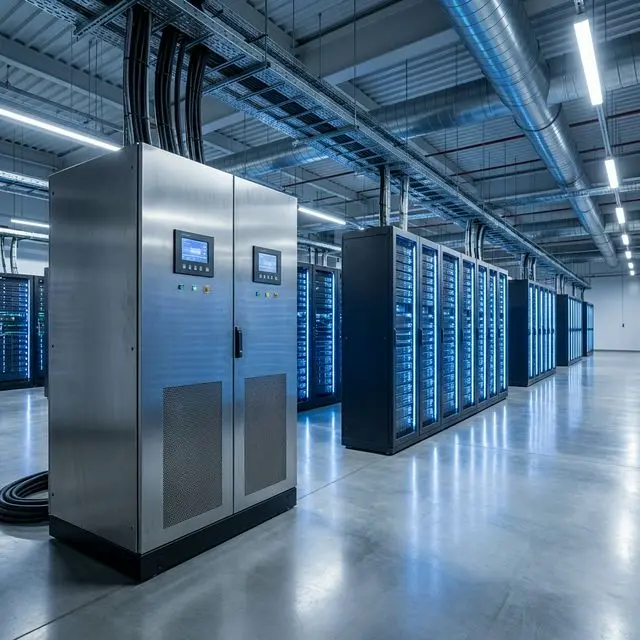
Tier 4 Data Center Capacitor Refresh
The Challenge
Critical DC bus capacitor degradation in 200 kVA UPS units approaching 6-year operational mark in high-density environment.
The Solution
Scheduled hot-swap replacement using Specap-sourced high-reliability, 105°C rated long-life electrolytic capacitors.
The Result
Successfully completed refresh for 45 units with zero unplanned downtime and 100% component availability.