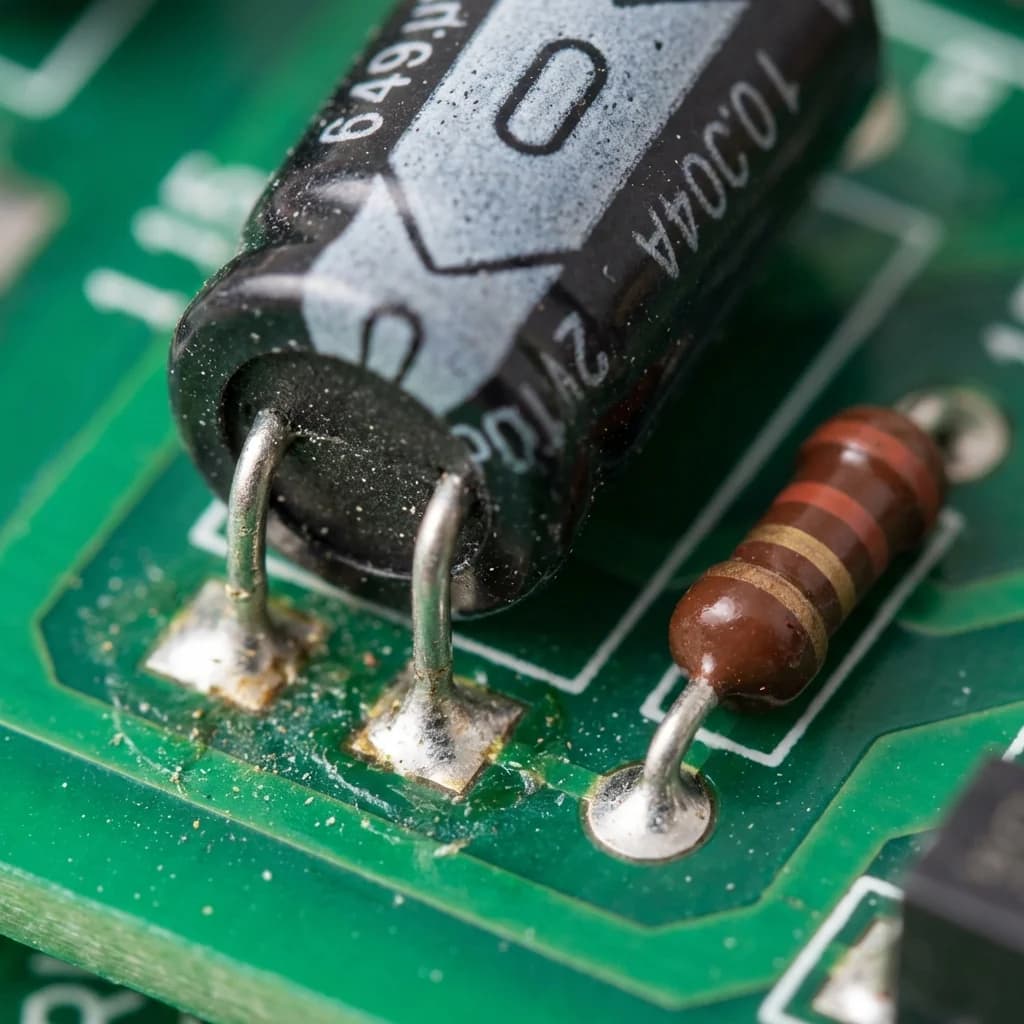
85C vs 105C Electrolytic Capacitors: Which Do You Need?
Last Updated: February 2026 | Reading Time: 14 minutes
You are sourcing aluminum electrolytic capacitors and notice two versions of the same part: one rated at 85C and another at 105C. The 105C version costs more. Is it worth the premium? Or is 85C good enough for your application?
The temperature rating on an electrolytic capacitor is not just a number---it directly determines how long the capacitor will last in your circuit. Understanding this relationship can mean the difference between a product that runs for a decade and one that fails in two years.
This guide explains the engineering behind temperature ratings, provides the math for calculating expected life, and gives practical guidance on when each rating makes sense.
- The temperature rating is the maximum ambient temperature for rated life---not the temperature at which the capacitor "burns up."
- Capacitor life doubles for every 10C reduction in operating temperature below the rated temperature (the Arrhenius equation applied to electrolyte evaporation).
- A 105C capacitor at 85C lasts roughly 4x longer than an 85C capacitor at 85C---because it has 20C of thermal headroom working in its favor.
- 85C capacitors are adequate for most consumer electronics where ambient temperatures stay well below 85C.
- 105C capacitors are essential for high-temperature environments: near heat sinks, inside enclosed equipment, automotive, industrial, and LED lighting applications.
- The cost premium for 105C is typically 20-50%---often a worthwhile investment for reliability-critical designs.
- ESR, ripple current rating, and impedance also tend to be better in 105C series---the higher-grade construction benefits more than just temperature performance.
| Specification | 85C Rated | 105C Rated |
|---|
| Maximum rated temperature | 85C (185F) | 105C (221F) |
| Rated life at max temperature | 1,000-5,000 hours typical | 2,000-10,000 hours typical |
| Life at 45C ambient (typical room) | 16,000-80,000 hours | 128,000-640,000+ hours |
| Typical ESR | Standard | Often lower |
| Ripple current rating | Standard | Often higher |
| Physical size | Standard | Same or slightly larger |
| Cost | Lower (baseline) | 20-50% premium |
| Construction quality | Standard electrolyte | Higher-grade electrolyte, improved seals |
| Primary applications | Consumer electronics, low-temp environments | Industrial, automotive, LED, high-reliability |
| Shelf life | Good | Better (slower electrolyte evaporation) |
The temperature printed on an electrolytic capacitor (85C or 105C) specifies the maximum ambient temperature at which the capacitor will achieve its rated operational life. It does not mean the capacitor instantly fails at that temperature.
For example, a capacitor marked "85C, 2000 hours" means:
- At exactly 85C ambient temperature, the capacitor is expected to last at least 2,000 hours of continuous operation
- Below 85C, it will last significantly longer (this is where the math gets interesting)
- Above 85C, it will fail more rapidly and may be damaged
Aluminum electrolytic capacitors contain a liquid or gel electrolyte that is essential to their operation. This electrolyte slowly evaporates through the rubber or elastomer seal over time. Higher temperatures accelerate this evaporation exponentially.
As the electrolyte evaporates:
- Capacitance decreases (less electrolyte means less effective electrode area)
- ESR increases (the electrolyte is part of the conductive path)
- Leakage current may increase (the oxide dielectric layer degrades without electrolyte to reform it)
- Eventually the capacitor is "end of life" when parameters drift beyond acceptable limits (typically defined as capacitance dropping 20% or ESR doubling)
The difference between an 85C and a 105C capacitor lies in the formulation of the electrolyte and the quality of the seal. A 105C capacitor uses a more thermally stable electrolyte chemistry and often a better-engineered seal, allowing it to withstand higher temperatures before the evaporation rate becomes unacceptable.
The rate of electrolyte evaporation in aluminum electrolytic capacitors follows the Arrhenius equation for chemical reaction rates. For practical engineering purposes, this simplifies to a widely used rule of thumb:
For every 10C decrease in operating temperature below the rated temperature, the expected life approximately doubles.
This is not an approximation---it is remarkably accurate for most aluminum electrolytic capacitors and is used by every major manufacturer in their reliability calculations.
L_operating = L_rated x 2^((T_rated - T_operating) / 10)
Where:
- L_operating = estimated life at your actual operating temperature
- L_rated = the rated life at the rated temperature (from the datasheet)
- T_rated = the rated temperature (85C or 105C)
- T_operating = the actual operating temperature of the capacitor (including self-heating)
Example 1: 85C capacitor rated for 2,000 hours
| Operating Temperature | Calculation | Estimated Life |
|---|
| 85C | 2,000 x 2^(0/10) = 2,000 x 1 | 2,000 hours |
| 75C | 2,000 x 2^(10/10) = 2,000 x 2 | 4,000 hours |
| 65C | 2,000 x 2^(20/10) = 2,000 x 4 | 8,000 hours |
| 55C | 2,000 x 2^(30/10) = 2,000 x 8 | 16,000 hours |
| 45C | 2,000 x 2^(40/10) = 2,000 x 16 | 32,000 hours (~3.7 years) |
| 35C | 2,000 x 2^(50/10) = 2,000 x 32 | 64,000 hours (~7.3 years) |
| 25C | 2,000 x 2^(60/10) = 2,000 x 64 | 128,000 hours (~14.6 years) |
Example 2: 105C capacitor rated for 2,000 hours
| Operating Temperature | Calculation | Estimated Life |
|---|
| 105C | 2,000 x 2^(0/10) = 2,000 x 1 | 2,000 hours |
| 95C | 2,000 x 2^(10/10) = 2,000 x 2 | 4,000 hours |
| 85C | 2,000 x 2^(20/10) = 2,000 x 4 | 8,000 hours |
| 75C | 2,000 x 2^(30/10) = 2,000 x 8 | 16,000 hours |
| 65C | 2,000 x 2^(40/10) = 2,000 x 16 | 32,000 hours (~3.7 years) |
| 55C | 2,000 x 2^(50/10) = 2,000 x 32 | 64,000 hours (~7.3 years) |
| 45C | 2,000 x 2^(60/10) = 2,000 x 64 | 128,000 hours (~14.6 years) |
| 35C | 2,000 x 2^(70/10) = 2,000 x 128 | 256,000 hours (~29.2 years) |
| 25C | 2,000 x 2^(80/10) = 2,000 x 256 | 512,000 hours (~58.4 years) |
Here is the comparison that matters most---both capacitor types at the same operating temperature, assuming both have a 2,000-hour rated life:
| Operating Temperature | 85C/2,000hr Capacitor | 105C/2,000hr Capacitor | 105C Advantage |
|---|
| 85C | 2,000 hr (0.23 yr) | 8,000 hr (0.91 yr) | 4x longer |
| 75C | 4,000 hr (0.46 yr) | 16,000 hr (1.83 yr) | 4x longer |
| 65C | 8,000 hr (0.91 yr) | 32,000 hr (3.65 yr) | 4x longer |
| 55C | 16,000 hr (1.83 yr) | 64,000 hr (7.31 yr) | 4x longer |
| 45C | 32,000 hr (3.65 yr) | 128,000 hr (14.6 yr) | 4x longer |
| 35C | 64,000 hr (7.31 yr) | 256,000 hr (29.2 yr) | 4x longer |
| 25C | 128,000 hr (14.6 yr) | 512,000 hr (58.4 yr) | 4x longer |
The 105C capacitor consistently lasts 4x longer at any given temperature. This is because it has 20C more headroom: 2^(20/10) = 4.
Ambient Temperature Is Not the Whole Story#
The operating temperature of a capacitor inside your equipment is not just the room temperature. It includes:
- External ambient temperature (room, outdoor, enclosure)
- Internal equipment temperature rise (other components generating heat, restricted airflow)
- Self-heating from ripple current (the capacitor's own ESR generates heat as AC current flows through it)
Total operating temperature = Ambient + Enclosure rise + Self-heating
| Heat Source | Typical Contribution |
|---|
| Room ambient (office/home) | 20-30C |
| Room ambient (industrial floor) | 25-45C |
| Outdoor ambient (summer, direct sun) | 40-60C |
| Inside sealed enclosure (no ventilation) | +15-30C above ambient |
| Near power semiconductors or heat sinks | +10-40C locally |
| Capacitor self-heating (low ripple) | +2-5C |
| Capacitor self-heating (high ripple, near limit) | +5-15C |
Example calculation for an indoor industrial application:
| Component | Temperature |
|---|
| Factory ambient | 35C |
| Inside equipment enclosure | +20C |
| Self-heating (moderate ripple) | +5C |
| Total operating temperature | 60C |
At 60C, an 85C/2,000-hour capacitor would last approximately 11,300 hours (1.3 years). A 105C/2,000-hour capacitor at the same 60C would last approximately 45,250 hours (5.2 years).
Consider these real-world situations where temperature can spike:
| Scenario | Possible Capacitor Temperature |
|---|
| Rooftop HVAC control panel in summer | 60-80C |
| LED driver inside enclosed fixture | 65-90C |
| Automotive under-hood electronics | 85-125C |
| Industrial VFD at full load, poor ventilation | 60-85C |
| Server room power supply (well-ventilated) | 35-50C |
| Outdoor telecom cabinet, desert climate | 55-75C |
An 85C capacitor is a perfectly valid choice when:
- The operating environment is climate-controlled (office, home, server room with HVAC)
- The capacitor is not near heat sources (away from power semiconductors, transformers, heat sinks)
- Ripple current is low relative to the rating (minimal self-heating)
- Product life requirement is moderate (consumer electronics with 3-5 year expected life)
- Cost optimization is a priority (high-volume consumer products)
| Application | Why 85C Is Adequate |
|---|
| Desktop computer power supply | Indoor, moderate airflow, 3-5 year life OK |
| Consumer audio equipment | Indoor, low stress, not near heat |
| General-purpose bench equipment | Controlled lab environment |
| Low-power LED drivers (open air) | Moderate temperature, low ripple |
| Hobby and prototype circuits | Cost-sensitive, not production |
In a 25C room with moderate internal heating bringing the capacitor to 40C:
- 85C/2,000-hour cap: estimated life = 2,000 x 2^(45/10) = ~45,250 hours = ~5.2 years
- 85C/5,000-hour cap: estimated life = 5,000 x 2^(45/10) = ~113,100 hours = ~12.9 years
Both are respectable lifespans for consumer applications.
A 105C capacitor is strongly recommended or required when:
- The capacitor is near heat-generating components (next to MOSFETs, IGBTs, diode bridges, transformers)
- The enclosure has limited ventilation (sealed outdoor boxes, compact industrial enclosures)
- Ambient temperature is elevated (industrial, automotive, outdoor)
- Product life requirement is long (industrial equipment: 10-20+ years expected service)
- Ripple current is high (switching power supply output, DC bus, inverter)
- Failure consequences are severe (medical equipment, safety systems, expensive-to-repair installations)
| Application | Why 105C Is Needed |
|---|
| Switching power supplies | Near hot semiconductors, high ripple current |
| LED drivers (enclosed fixtures) | Sealed enclosure, heat from LEDs, long life required |
| Automotive electronics | Under-hood temperatures, vibration, long life |
| Industrial motor drives (VFDs) | High ambient, high ripple, 10+ year life expectation |
| HVAC control boards | Outdoor/attic installations, temperature extremes |
| UPS and backup power systems | Continuous duty, reliability critical |
| Medical devices | Reliability critical, regulatory requirements |
| Telecom equipment | Remote locations, outdoor cabinets, 15-20 year life |
| Military and aerospace | Extreme environments, mission critical |
| Server power supplies | 24/7 operation, high airflow (but still hot internally) |
In a 55C enclosed industrial environment:
- 85C/2,000-hour cap: estimated life = 2,000 x 2^(30/10) = 16,000 hours = ~1.8 years
- 105C/2,000-hour cap: estimated life = 2,000 x 2^(50/10) = 64,000 hours = ~7.3 years
- 105C/5,000-hour cap: estimated life = 5,000 x 2^(50/10) = 160,000 hours = ~18.3 years
For equipment expected to last 10+ years, only the 105C/5,000-hour option meets the requirement in this environment.
105C electrolytic capacitors are generally manufactured with higher-grade materials, and this often extends to lower ESR and impedance---not just higher temperature performance.
| Parameter | Typical 85C Series | Typical 105C Series |
|---|
| ESR at 100 kHz | Standard | Often 20-40% lower |
| Impedance at 100 kHz | Standard | Often lower |
| Ripple current rating | Standard | Often 10-30% higher |
| Tan delta (dissipation factor) | Standard | Often lower |
Lower ESR means less self-heating under the same ripple current, which further extends life---a compounding benefit on top of the higher temperature rating.
Because 105C capacitors typically have lower ESR and are built with better thermal management, they can handle more ripple current:
Example: 1000 uF, 25V capacitor
| Parameter | 85C Series (typical) | 105C Series (typical) |
|---|
| Rated ripple current (105 Hz) | 800 mA | 1,100 mA |
| Rated ripple current (100 kHz) | 1,000 mA | 1,400 mA |
In switching power supply applications where ripple current is significant, this higher rating can be the deciding factor---not just the temperature.
The 105C rating demands better materials throughout:
- Electrolyte formulation: More thermally stable organic solvents, optimized for minimal evaporation at high temperatures
- Rubber seal: Higher-grade EPDM or butyl rubber with lower permeability
- Electrode foil: Often higher-purity aluminum with better-formed oxide layer
- Assembly quality: Tighter manufacturing tolerances
These improvements benefit the capacitor even when it operates at low temperatures, contributing to lower failure rates and better long-term parameter stability.
To estimate the expected capacitor life in your application:
Step 1: Determine the actual capacitor operating temperature
T_operating = T_ambient + T_enclosure_rise + T_self_heating
Where T_self_heating can be estimated from:
T_self_heating = (I_ripple)^2 x ESR x Thermal_resistance
Most manufacturers provide thermal resistance data or self-heating curves in their datasheets.
Step 2: Apply the life estimation formula
L_operating = L_rated x 2^((T_rated - T_operating) / 10)
Step 3: Compare to your product life requirement
If L_operating > Required_life, the capacitor is adequate. If not, consider:
- A 105C capacitor if currently using 85C
- A longer-rated-life capacitor (e.g., 5,000 hours instead of 2,000 hours)
- Reducing the operating temperature (better ventilation, thermal management, moving the cap away from heat)
| Application Type | Recommended Life Margin |
|---|
| Consumer electronics (3-5 year life) | 1.5x to 2x expected life |
| Industrial equipment (10-15 year life) | 2x to 3x expected life |
| Telecom / infrastructure (15-20+ year life) | 3x to 5x expected life |
| Medical / safety-critical | 3x to 5x expected life minimum |
Example: An industrial control system expected to operate 24/7 for 15 years = 131,400 hours. With a 2x safety margin, you need a capacitor with an estimated life of 262,800 hours at the actual operating temperature. Work backward through the formula to determine whether an 85C or 105C capacitor (and what rated life) meets this requirement.
Reality: 85C is the rated temperature for the specified life, not an instant failure point. The capacitor will work above 85C, but its life decreases rapidly---roughly halving for every 10C above the rating. Brief excursions above rated temperature are generally survivable but reduce overall life.
Reality: 105C capacitors provide 4x longer life than equivalent 85C capacitors at any temperature. Even in a cool 25C environment, the 105C version will significantly outlast the 85C version. The premium is buying you reliability, not just heat tolerance.
Reality: Storage temperature limits are different from operating temperature limits. Non-operating storage limits are typically higher (up to 105C even for 85C-rated parts in many cases) because there is no electrical stress or ripple-current self-heating during storage. However, prolonged storage at high temperature still causes some electrolyte evaporation. Check the specific datasheet for storage temperature specifications.
Reality: Capacitors are difficult to heat sink effectively. Their cylindrical shape and flexible sleeves make thermal coupling poor. While reducing ambient temperature through better system thermal design is valid, "heat sinking a capacitor" is not a practical or reliable solution.
Reality: A cheap 105C/1,000-hour capacitor may not outlast a premium 85C/5,000-hour capacitor at moderate temperatures. Always compare the full specification, not just the temperature rating. Rated life (in hours) at the rated temperature is the starting point for any comparison.
| Question | If Yes | If No |
|---|
| Is the capacitor inside a sealed enclosure? | Lean toward 105C | 85C may be fine |
| Is it near power semiconductors or heat sinks? | Use 105C | 85C may be fine |
| Is the equipment expected to last 10+ years? | Use 105C | 85C is often adequate |
| Is ripple current more than 50% of rated? | Use 105C (better ESR) | 85C may be fine |
| Is the ambient temperature above 40C? | Use 105C | 85C is often adequate |
| Is the equipment in an outdoor or unconditioned space? | Use 105C | 85C may be fine |
| Is the application safety-critical or medical? | Use 105C | Depends on other factors |
| Is the cost premium a major concern? | Consider 85C if temps allow | Use 105C for peace of mind |
Many experienced designers default to 105C electrolytic capacitors in all new designs. The reasoning is straightforward:
- The cost difference is modest (20-50% premium, often just pennies per unit)
- The reliability improvement is significant (4x life advantage)
- It provides insurance against unexpected temperature increases (installation in hot climates, poor ventilation, adjacent heat sources)
- It simplifies inventory and BOM management (one temperature grade covers all applications)
- It reduces warranty claims and field failures
The cases where 85C makes economic sense are high-volume consumer products with known-benign thermal environments and short expected product life.
Yes, always. A 105C capacitor is a direct upgrade from an 85C capacitor of the same value and voltage. It will fit the same footprint (same or very similar physical dimensions) and provide longer life and often better electrical performance.
Only if the operating temperature is well below 85C and you have confirmed the 85C part will meet your required life. This is a downgrade and should be done only when the 105C part is unavailable and you have verified the thermal conditions. For critical applications, this substitution is not recommended.
If the power supply is a switching type (SMPS), 105C capacitors are strongly recommended for the output and input bulk capacitors. These locations experience high ripple current (self-heating) and are often near hot power semiconductors. For linear power supplies operating in benign environments, 85C may be adequate.
Often, yes. The higher-grade construction of 105C series typically includes lower ESR and impedance compared to the 85C equivalent. This is not guaranteed---always check the specific datasheet---but it is a common trend across manufacturers.
It depends entirely on the operating temperature. A 105C/5,000-hour capacitor in a 45C environment has an estimated life of about 640,000 hours (73 years). The same capacitor at 85C has an estimated life of about 20,000 hours (2.3 years). Temperature is the dominant factor.
Polymer aluminum electrolytic capacitors use a solid conductive polymer instead of liquid electrolyte. They have much lower ESR, longer life, and no electrolyte evaporation failure mode. However, they are more expensive and available in a narrower range of values and voltages. They are an excellent choice for switching power supply outputs where low ESR and long life are critical.
The 10C doubling rule applies specifically to aluminum electrolytic capacitors with liquid or gel electrolyte. It does not apply to ceramic capacitors, film capacitors, or solid polymer electrolytic capacitors, which have different failure mechanisms. Tantalum electrolytic capacitors have their own temperature-life relationships that differ from aluminum types.
Use a thermocouple or infrared thermometer on the capacitor body during worst-case operation (maximum ambient temperature, maximum load, no fan failure, steady-state). Measure at the hottest point, typically the top vent area. Allow the system to reach thermal equilibrium (30-60 minutes minimum) before recording the temperature.
- Capacitor Derating Guide — Voltage, temperature, and ripple current derating tables with MIL-STD standards for calculating safe operating margins
- Capacitor Shelf Life & Storage — Storage conditions and reforming procedures — temperature rating affects shelf life too
- Capacitor Types Guide — Complete comparison of all capacitor types including temperature rating options across technologies
Specap carries a comprehensive selection of aluminum electrolytic capacitors in both 85C and 105C ratings---from standard radial and axial types to computer-grade screw terminal capacitors for industrial applications.
Specap has been a trusted capacitor supplier since 1984. Whether you are designing new equipment and need to select the right temperature rating, or replacing worn capacitors in existing systems, our team can help you find the right part. We stock both standard and long-life electrolytic capacitors from leading manufacturers---contact us for specifications, availability, and volume pricing.