
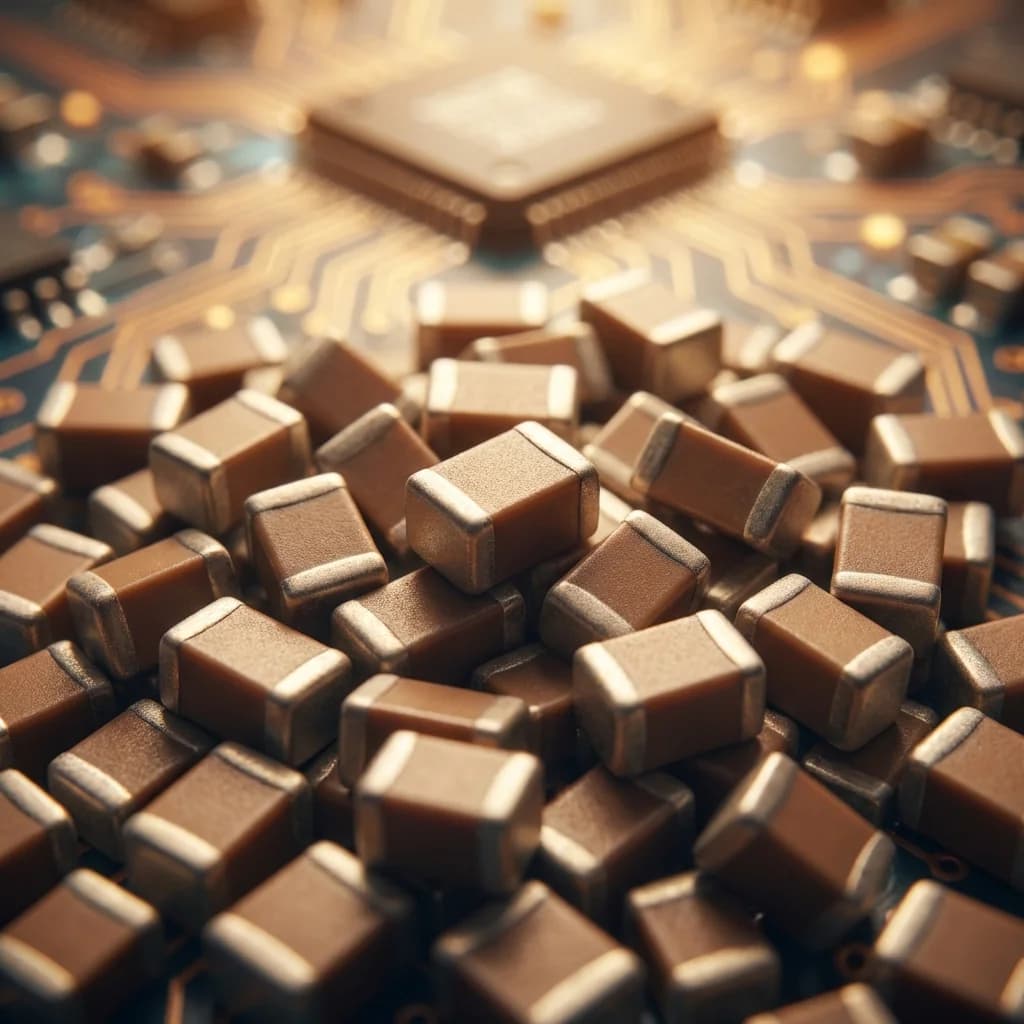
Ceramic Capacitors
Premium Component Solutions
Compact, high-frequency capacitors available from miniature MLCC to high-voltage disc types for RF and general purpose use.
Typical Specifications
Common Applications
Selection Tips
Capacitor Calculators
Use our free calculators to help with your ceramic capacitors capacitor selection and circuit design
Understanding Ceramic Capacitors
Ceramic capacitors are the most widely used capacitor type, with billions manufactured annually. They range from tiny multilayer chip capacitors (MLCC) measured in fractions of a millimeter to large disc capacitors for high-voltage applications.
MLCC (Multilayer Ceramic Chip Capacitors)
MLCCs consist of alternating layers of ceramic dielectric and metal electrodes, fired into a monolithic structure. This construction achieves high capacitance in extremely small packages - essential for modern electronics.
Dielectric Classes
Class 1 (C0G/NP0): Temperature-compensating dielectrics with excellent stability. Capacitance varies less than ±30ppm/°C. Very low losses (high Q). Used in timing, filtering, and resonant circuits where stability matters.
Class 2 (X7R, X5R): High-permittivity dielectrics providing much higher capacitance than Class 1. Capacitance varies with temperature (±15%), voltage (DC bias effect), and time. Used for decoupling and filtering where exact value is less critical.
Class 3 (Y5V, Z5U): Maximum capacitance density but poorest stability. Large capacitance change with temperature and voltage. Used for bypass and bulk decoupling where stability is unimportant.
Key Characteristics
DC Bias Effect: Class 2 and 3 ceramic capacitors lose significant capacitance when DC voltage is applied. A capacitor rated 10µF may provide only 3µF at rated voltage. Datasheets show derating curves.
Piezoelectric Effects: Some ceramic dielectrics exhibit piezoelectric behavior, converting electrical energy to mechanical vibration. This can cause audible noise and microphonic sensitivity.
Aging: Class 2 and 3 dielectrics show capacitance decrease over time (aging). The rate is logarithmic - most change occurs soon after manufacturing. Aging can be reset by heating above Curie temperature.
Size Limitations: Minimum practical size depends on capacitance and voltage. Very high capacitance in small packages requires Class 2/3 dielectrics with their associated compromises.
Ceramic Capacitors for RF and Wireless
Ceramic capacitors are the dominant capacitor technology in radio frequency (RF) and wireless applications. Their low ESR, low ESL, and availability in extremely small packages make them essential for impedance matching, filtering, DC blocking, and bypassing at frequencies from MHz to GHz.
Impedance Matching Networks: RF transmitters and receivers use tuned LC networks to match impedance between stages. Class 1 (C0G/NP0) ceramic capacitors are preferred for matching networks because their capacitance does not change with applied voltage or temperature, ensuring consistent impedance across operating conditions. High-Q C0G capacitors minimize insertion loss, preserving signal strength and improving receiver sensitivity. For [telecom infrastructure](/applications/telecom), where matching networks must maintain performance across wide temperature ranges and over many years, C0G ceramics are the standard choice.
RF Filtering: Band-pass, low-pass, and high-pass filters in RF systems rely on ceramic capacitors with predictable, stable values. Filter performance degrades rapidly if component values drift, making Class 1 ceramics essential. Multi-layer ceramic capacitors designed specifically for RF use feature controlled parasitic characteristics and well-defined self-resonant frequencies to maintain predictable behavior at the operating frequency.
Bypass and Decoupling at RF: High-frequency bypassing in RF circuits requires capacitors with very low impedance at the operating frequency. The self-resonant frequency of the capacitor must be considered — below self-resonance the capacitor behaves capacitively, above it the capacitor becomes inductive. Designers often place multiple capacitors of different values in parallel to maintain low impedance across a broad frequency range. Physical placement is critical; capacitors must be as close to the active device as physically possible, with minimal trace length.
RF Power Amplifiers: High-power RF amplifiers for base stations, broadcast transmitters, and industrial heating use specialized high-voltage, high-current ceramic capacitors. Porcelain and multilayer ceramic capacitors rated at several kilovolts handle the RF voltages present in power amplifier output networks. These capacitors must dissipate significant power from dielectric and resistive losses without overheating.
High Voltage Ceramic Capacitors
Ceramic capacitors for high-voltage applications extend from a few hundred volts to tens of kilovolts, serving applications from power supplies to medical imaging equipment to particle accelerators.
Disc Ceramic Capacitors: Traditional disc ceramic capacitors are single-layer devices consisting of a ceramic disc with silver or silver-palladium electrodes. Available in voltages up to 50kV, disc ceramics are workhorses in CRT displays, X-ray equipment, laser power supplies, and high-voltage test equipment. Both Class 1 (stable) and Class 2 (high capacitance) dielectrics are available in disc format.
Doorknob and Barrel Capacitors: For the highest voltages and currents, doorknob-shaped ceramic capacitors provide robust construction with adequate creepage and clearance distances. Used in broadcast transmitters, industrial RF heating, and pulsed power systems, these capacitors handle peak currents of hundreds of amps at kilovolt-level voltages.
High-Voltage MLCC: Multilayer ceramic capacitors rated above 500V serve switch-mode power supplies, LED drivers, and isolated power converters. High-voltage MLCCs are available up to 5000V in smaller case sizes (0805, 1206, 1210, 1812) and even higher voltages in larger packages. The design challenge is maintaining adequate dielectric thickness between layers while achieving useful capacitance values.
Applications in Medical and Scientific Equipment: High-voltage ceramic capacitors are critical components in X-ray generators, CT scanners, MRI systems, and laboratory power supplies. These applications demand capacitors that reliably withstand high voltage while maintaining stable capacitance under varying load conditions. For [aerospace and defense applications](/applications/aerospace) involving high-altitude or vacuum environments, ceramic capacitors' solid construction eliminates the corona discharge concerns that can affect other capacitor technologies.
MLCC Shortage and Sourcing
The global MLCC shortage that began in 2017-2018 fundamentally changed how the electronics industry approaches ceramic capacitor procurement. While the most acute supply-demand imbalances have eased, the lessons learned remain highly relevant for procurement professionals and design engineers.
What Caused the Shortage: A combination of factors created the shortage: explosive growth in MLCC demand from automotive electronics (each modern vehicle uses 5,000-10,000+ MLCCs), smartphone content growth, and data center expansion. Simultaneously, major manufacturers reallocated production capacity from standard commodity sizes to high-value automotive and industrial grades, reducing availability of common consumer specifications.
Ongoing Sourcing Challenges: Even as general MLCC supply has improved, specific combinations of dielectric, voltage, capacitance, package size, and temperature rating can have extended lead times. Automotive-grade (AEC-Q200) and high-reliability specifications remain supply-constrained. Obsolete MLCC part numbers from manufacturer portfolio rationalization create additional sourcing gaps. When standard distribution channels show long lead times, Specap can often source from deep inventory or alternative manufacturer cross-references.
Design Strategies for Supply Resilience: Engineers can mitigate MLCC sourcing risk through several design approaches. Using standard EIA case sizes (0402, 0603, 0805, 1206) rather than non-standard sizes ensures the broadest supply base. Designing for multiple manufacturer footprints and specifications allows procurement flexibility. Avoiding single-source specifications and qualifying alternative parts during the design phase prevents supply disruptions from becoming production stoppages.
Specap MLCC Sourcing: Specap maintains stock of commonly specified MLCCs across a range of dielectrics, voltages, and case sizes. For hard-to-find or allocated MLCC part numbers, our sourcing team can search global inventory and identify pin-compatible alternatives. Contact us for volume pricing and availability on any MLCC requirement.
Ceramic vs Film: When to Use Each
Ceramic and film capacitors overlap in capacitance range and voltage range, but their performance characteristics differ significantly. Choosing between them requires understanding how each technology behaves in the target application.
Choose Ceramic When: Space is the primary constraint and you need the smallest possible package; the application requires very high frequency operation (above a few MHz); stable, low-value capacitance is needed (C0G/NP0 for pF to low nF range); automated SMD assembly is required and the capacitor value is available in MLCC format; cost is a driving factor for small capacitance values.
Choose Film When: Capacitance stability under DC bias is critical (Class 2 ceramics lose 50-80% of capacitance at rated voltage; film capacitors do not); AC voltage handling is required (motor run, PFC, EMI filtering); self-healing capability improves reliability; low piezoelectric noise is important (audio, sensitive analog circuits); pulse and high dv/dt applications demand robust dielectric; high capacitance with linear characteristics is needed.
The Overlap Zone: In the 1nF to 10uF range at voltages from 25V to 630V, both ceramic and film capacitors are available. For DC decoupling and bypass where exact capacitance is not critical, ceramic is typically more cost-effective and compact. For signal path, timing, and analog applications where capacitance accuracy and linearity matter, film is the superior choice. For power applications with significant AC components, film is generally preferred.
For a detailed comparison including equivalent circuit models and performance data, see our technical resources. When evaluating alternatives between ceramic and film for a specific design, Specap's technical team can provide application-specific recommendations.
Ceramic Capacitors for Automotive Electronics
The automotive industry has become the largest growth driver for high-reliability ceramic capacitors. Modern vehicles contain thousands of MLCCs across engine control units, infotainment systems, ADAS (advanced driver assistance systems), EV power electronics, and safety-critical subsystems.
AEC-Q200 Qualification: Automotive-grade MLCCs must pass AEC-Q200 qualification testing, which includes temperature cycling (-55C to +150C for 1000 cycles), humidity resistance (85C/85% RH for 1000 hours), mechanical shock, vibration, and board flex testing. These requirements ensure the capacitors survive the harsh automotive environment over 15+ year vehicle lifetimes. AEC-Q200 qualified parts carry a price premium and may have longer lead times than commercial equivalents.
EV and Hybrid Power Electronics: Electric vehicle inverters, onboard chargers, and DC-DC converters use ceramic capacitors for high-frequency bypassing and snubbing. The high switching frequencies (100kHz-1MHz) in SiC and GaN-based power stages demand capacitors with extremely low ESL and ESR at the switching frequency. C0G ceramic capacitors in 1206 and 1210 packages provide the combination of voltage rating, current handling, and parasitic performance needed for wide-bandgap semiconductor gate drives.
Flex-Safe and Open-Mode Fail-Safe MLCCs: To address the flex cracking problem in automotive applications, manufacturers have developed specialized MLCC constructions. Flexible termination capacitors use conductive epoxy between the ceramic body and the solder fillet, absorbing board flex without transmitting mechanical stress to the ceramic. Open-mode fail-safe MLCCs are designed so that if a crack does occur, the capacitor fails open rather than short, preventing potential safety hazards in critical circuits.
Ceramic Capacitors in 5G and Next-Generation Wireless
The rollout of 5G wireless networks and the proliferation of IoT devices have intensified demand for ceramic capacitors with performance characteristics tailored to millimeter-wave frequencies and massive MIMO antenna systems.
Millimeter-Wave Frequencies: 5G networks operating at 24-40 GHz and above require passive components with extremely well-controlled parasitic characteristics. At millimeter-wave frequencies, even picohenries of parasitic inductance significantly affect circuit behavior. Specialized RF ceramic capacitors with ground-signal-ground (GSG) terminations and tightly controlled ESL enable designers to build matching networks and filters that function predictably at these frequencies.
Massive MIMO Base Stations: Each 5G massive MIMO base station contains 64-256 antenna elements, each with its own RF chain. The sheer number of RF channels multiplies the demand for RF ceramic capacitors — impedance matching, DC blocking, and bypass capacitors are needed for every channel. The [telecom infrastructure](/applications/telecom) buildout represents a sustained, multi-year demand driver for high-performance ceramic capacitors.
Small Cell and Distributed Antenna Systems: Small cell deployments for 5G densification require compact, high-performance ceramic capacitors that operate reliably in outdoor enclosures subject to wide temperature ranges and humidity. Class 1 (C0G/NP0) ceramics maintain stable capacitance across temperature extremes, while their compact MLCC format fits the space constraints of small cell radio units.
Ceramic Capacitor Handling and Assembly Considerations
The brittle nature of ceramic capacitors creates unique handling and assembly challenges that procurement and manufacturing teams must understand to prevent costly field failures.
Flex Cracking Prevention: The most common cause of ceramic capacitor failure in assembled products is flex cracking — fractures caused by PCB bending during depaneling, connector insertion, screw fastening, or in-service mechanical loads. Best practices include placing large MLCCs (1210 and above) away from board edges and mounting holes, orienting the capacitor's long axis parallel to the board edge to reduce bending stress, using flexible termination types for case sizes 1206 and larger, and supporting the PCB during any assembly operations that generate bending forces.
Tombstoning and Solder Defects: During reflow soldering, unbalanced solder paste volume or uneven heating can cause one end of an MLCC to lift off the pad — a defect called tombstoning. Proper stencil design, pad geometry, and reflow profile optimization minimize tombstoning. This is particularly critical for small case sizes (0201, 0402) where the component weight is insufficient to resist the capillary forces of molten solder.
ESD Sensitivity: While ceramic capacitors are generally robust against electrostatic discharge, very thin dielectric layers in high-capacitance Class 2 MLCCs can be vulnerable to ESD events during handling. Observing standard ESD precautions during storage and assembly protects against latent defects that might not appear until the product is in service.
For assistance selecting the right ceramic capacitor for your application, or to source hard-to-find MLCC specifications, contact Specap's technical team. We maintain inventory across all major ceramic capacitor categories from leading manufacturers for both [aerospace](/applications/aerospace) and commercial applications.
For a comprehensive comparison of ceramic versus other capacitor technologies, see our <a href="/resources/guides/capacitor-types">Capacitor Types Guide</a>. Engineers working with voltage and temperature derating should also consult our <a href="/resources/guides/capacitor-derating">Capacitor Derating Guide</a>. Use our free <a href="/resources/calculators/capacitor-value">Capacitor Value Calculator</a> to convert between pF, nF, and µF units.
Ceramic Capacitors FAQs
Common questions about this capacitor type
Request a Quote
Get competitive pricing tailored to your specific requirements.
Need a Substitute?
Our engineers cross-reference specs to find compatible alternates that meet or exceed your original part.
Find AlternatesObsolete Part?
We specialize in sourcing discontinued and hard-to-find capacitors with full traceability documentation.
Source Obsolete PartBulk Buy?
Volume pricing with same-day quotes. We stock large quantities and offer blanket order programs.
Get Bulk PricingRelated Resources
Explore our technical resources to learn more about ceramic capacitors capacitors and make better selection decisions.
Capacitor Types Guide
Compare all capacitor technologies and their ideal use cases
Derating Guide
Voltage and temperature derating best practices for reliability
Capacitor Glossary
Definitions for ESR, ripple current, dielectric, and 50+ terms
Cross-Reference Tool
Find equivalent replacements for obsolete or discontinued parts
Explore Related Topics
Related Categories
Common Applications
Need Help Selecting Ceramic Capacitors?
Our expert team has decades of experience helping customers find the right capacitors. Contact us for technical guidance or custom quotes.