
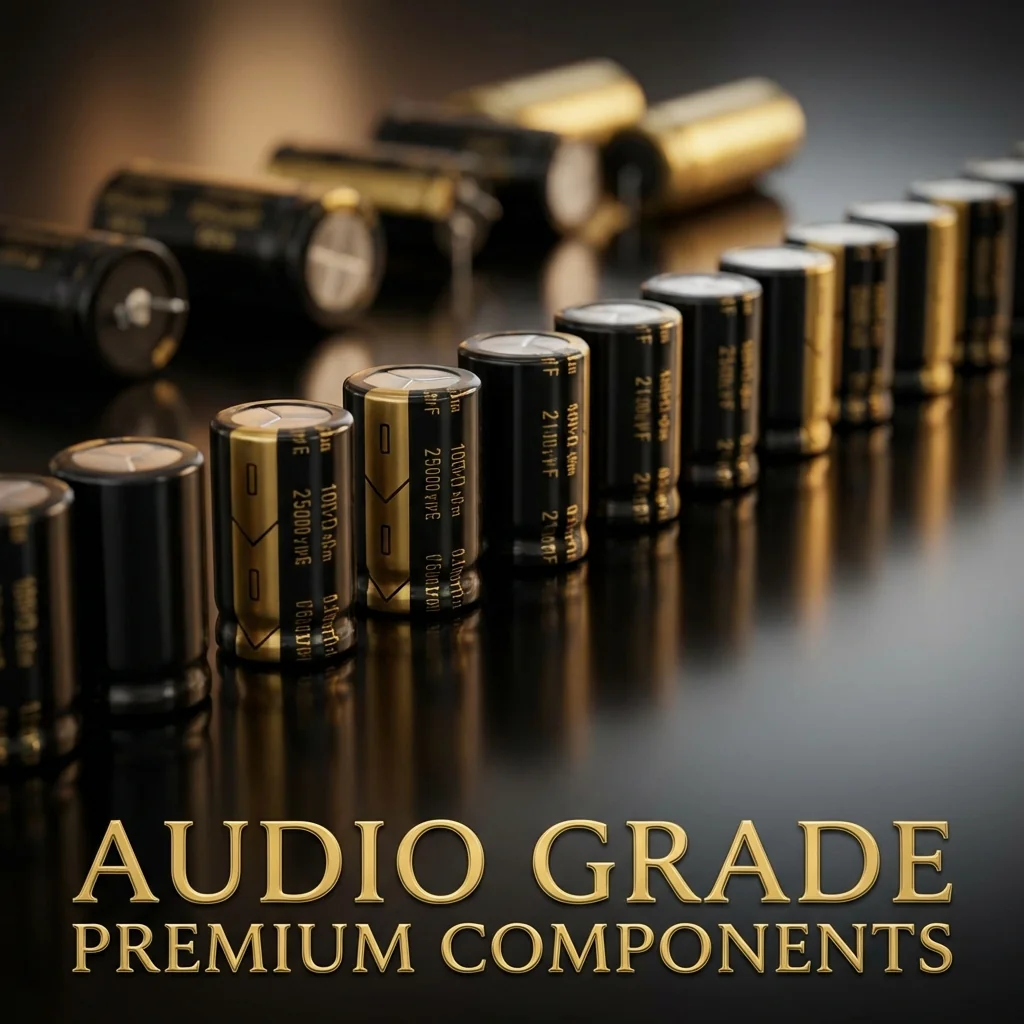
Electrolytic Capacitors
Premium Component Solutions
Buy electrolytic capacitors online — radial, axial, snap-in & screw terminal. 6.3V-500V, 85°C & 105°C. 10,000+ SKUs in stock, ships same-day. Volume discounts. Free technical support from Specap.
Typical Specifications
Common Applications
Selection Tips
Capacitor Calculators
Use our free calculators to help with your electrolytic capacitors capacitor selection and circuit design
Understanding Aluminum Electrolytic Capacitors
Aluminum electrolytic capacitors offer the highest capacitance values per unit volume among commonly used capacitor types, making them indispensable in power electronics and audio applications.
Construction and Technology
Aluminum electrolytic capacitors consist of two aluminum foils - an anode foil with an oxide layer dielectric and a cathode foil - separated by paper saturated with liquid electrolyte. The oxide layer, formed through an electrochemical process called "forming," provides the dielectric insulation.
The effective surface area of the anode foil is increased through etching, allowing high capacitance in a compact package. Higher voltage ratings require thicker oxide layers, which reduce capacitance for a given size.
Key Characteristics
Polarization: Standard aluminum electrolytic capacitors are polarized - they must be connected with correct polarity to prevent damage or failure. Bipolar (non-polarized) versions are available for AC applications.
ESR (Equivalent Series Resistance): Electrolytic capacitors have higher ESR than film or ceramic types due to the ionic conduction in the electrolyte. Lower ESR is achieved through improved electrolyte formulations and construction techniques.
Temperature Sensitivity: Capacitance and ESR vary with temperature. Electrolyte freezing at low temperatures and accelerated degradation at high temperatures limit the operating range.
Life Expectancy: Electrolyte evaporation over time is the primary aging mechanism. Life is typically specified at maximum rated temperature and roughly doubles for every 10°C reduction in operating temperature. When aging capacitors need replacement in legacy equipment, Specap's [obsolete capacitor sourcing](/obsolete-capacitors) service can locate discontinued part numbers or cross-reference modern equivalents.
Types and Variations
Standard Radial and Axial: General-purpose capacitors for through-hole mounting
SMD Chip: Surface mount aluminum electrolytic for automated assembly
Snap-In: Large capacitors with snap-in terminals for power applications
Screw Terminal: Heavy-duty capacitors for industrial power equipment
Polymer Electrolytic: Solid polymer electrolyte replacing liquid for lower ESR and longer life
Hybrid: Combining liquid and polymer electrolyte characteristics
For a full comparison of aluminum electrolytic types alongside film, ceramic, tantalum, and other technologies, see our <a href="/resources/guides/capacitor-types">Capacitor Types Guide</a>.
Electrolytic Capacitors for Power Supplies
Power supplies are the largest single application for aluminum electrolytic capacitors. Every switched-mode power supply, linear regulator, and server power module depends on electrolytic capacitors for energy storage, filtering, and decoupling.
Switching Power Supplies (SMPS): In switching power supplies, electrolytic capacitors serve two critical roles. Input capacitors store energy from the rectified mains and must handle high ripple current at the switching frequency. Output capacitors filter the switched waveform to deliver smooth DC to the load. Low-ESR capacitors are essential on the output side because ESR directly contributes to output voltage ripple. For high-frequency switching converters operating above 100kHz, polymer or hybrid electrolytic capacitors are increasingly preferred for their lower ESR and impedance at frequency.
SMPS designers must carefully evaluate ripple current ratings. The RMS ripple current flowing through bulk input capacitors generates internal heat proportional to I-squared times ESR. Exceeding the rated ripple current is the most common cause of premature capacitor failure in power supplies. Specap stocks low-ESR electrolytic capacitors from leading manufacturers including [Nichicon](/brands/nichicon), Panasonic, Rubycon, and United Chemi-Con for power supply applications.
Linear Power Supplies: Linear regulators require large-value electrolytic capacitors on both input and output to maintain low ripple. Because linear supplies operate at line frequency (50/60Hz or 100/120Hz after full-wave rectification), the ripple frequency is low and the capacitors must store substantial energy. This typically requires large capacitance values — 10,000uF or more is common in high-current linear supplies. Screw terminal and snap-in capacitors are standard choices for these applications.
Server and Telecom Power: Modern server power supplies demand the highest performance electrolytic capacitors. These applications require extended temperature ratings (105C minimum), extremely low ESR, high ripple current capability, and proven reliability over 50,000+ hour operational lifetimes. Polymer aluminum electrolytic and hybrid types dominate this space, often paired with ceramic decoupling capacitors for broadband impedance control.
Electrolytic Capacitors for Industrial Equipment
Industrial environments subject capacitors to extreme conditions: high ambient temperatures, vibration, voltage transients, and duty cycles that push components to their ratings. Aluminum electrolytic capacitors designed for industrial use feature ruggedized construction, extended temperature range, and enhanced vibration resistance.
Variable Frequency Drives (VFDs): VFDs are one of the most demanding applications for electrolytic capacitors. The DC bus capacitor bank in a VFD stores energy from the rectified three-phase mains and delivers it to the inverter stage. These capacitors must handle continuous high ripple current at both line frequency and switching frequency harmonics. Typical VFD DC bus capacitor banks use multiple large snap-in or screw terminal electrolytic capacitors in parallel to achieve the required capacitance and ripple current rating. When VFD capacitors fail, the entire drive goes down, causing costly production stoppages. Specap provides rapid replacement of [industrial capacitors](/applications/industrial) for VFD maintenance and repair.
Motor Drives and Servo Systems: DC servo drives and stepper motor drivers use electrolytic capacitors on the bus to absorb regenerative energy during deceleration. The capacitors experience high peak currents and wide voltage swings. Selecting capacitors with adequate voltage margin and ripple current rating is critical. For legacy servo drives where original capacitors have been discontinued, Specap specializes in [sourcing obsolete capacitors](/obsolete-capacitors) and identifying modern cross-references.
Welding Equipment: Resistance welders, MIG/TIG inverter welders, and spot welders draw enormous peak currents from their capacitor banks. Large-value screw terminal capacitors rated for high ripple current and pulse applications are standard. Welding applications also demand high surge voltage capability because regenerative events can create voltage spikes above the nominal bus voltage.
UPS Systems: Uninterruptible power supplies depend on electrolytic capacitors in the PFC stage, DC bus, and output filter. Because UPS systems operate continuously, capacitor life is a primary design concern. The typical 10-year service life expectation for UPS equipment means the electrolytic capacitors — often the shortest-lived components — may need replacement during the system's operational lifetime. Specap supplies replacement capacitors for [UPS systems](/applications/ups) from major manufacturers including Eaton, APC/Schneider, and Vertiv.
Computer-Grade Screw Terminal Capacitors
Computer-grade screw terminal electrolytic capacitors are the workhorses of industrial power electronics. These large-format capacitors, typically ranging from 1,000uF to 100,000uF with voltage ratings from 25V to 500V, are used in DC bus applications for motor drives, inverters, UPS systems, power supplies, and welding equipment.
**Why Screw Terminal?** Screw terminals provide a low-resistance, high-current connection that does not rely on solder joints. This is critical for capacitors carrying tens or hundreds of amps of ripple current, where resistive losses at the connection point would generate destructive heat. Screw terminals also allow field replacement without soldering.
Computer-Grade vs Standard: The term "computer-grade" indicates capacitors designed for continuous-duty, high-reliability applications rather than intermittent consumer use. Computer-grade capacitors feature enhanced electrolyte formulations for longer life, heavier-gauge terminals, improved sealing, and tighter manufacturing controls. They carry guaranteed minimum life ratings at maximum temperature, typically 3,000 to 20,000 hours at 85C or 105C.
Sourcing Challenges: Screw terminal computer-grade capacitors are frequently the components that fail in aging industrial equipment, and they are also among the most commonly discontinued part numbers. Equipment installed in the 1980s and 1990s often used capacitors from manufacturers that have since merged, been acquired, or exited the market. Specap maintains deep inventory of current-production screw terminal capacitors from [Cornell Dubilier](/brands/cornell-dubilier), [Nichicon](/brands/nichicon), Kemet, and others, and provides cross-reference services for discontinued part numbers.
How to Select the Right Electrolytic Capacitor
Selecting the correct aluminum electrolytic capacitor requires evaluating several interrelated parameters. Following a systematic approach prevents both over-specification (which wastes cost and space) and under-specification (which leads to premature failure).
**Step 1 — Define the voltage requirement.** Determine the maximum DC voltage the capacitor will experience, including transients and startup conditions. Select a voltage rating at least 20% above this maximum. For applications with frequent voltage spikes or unreliable input power, increase the derating to 30-50%. Higher voltage ratings also reduce the stress on the dielectric and extend capacitor life.
Step 2 — Determine the required capacitance.: Calculate the minimum capacitance based on the circuit requirements: energy storage, holdup time, ripple voltage limits, or filtering requirements. Consider that electrolytic capacitor tolerance is typically -20% to +20%, so the design must work at the minimum capacitance.
**Step 3 — Calculate ripple current.** Determine the RMS ripple current that will flow through the capacitor at all relevant frequencies. Compare this to the capacitor's rated ripple current. The rated ripple current generates the maximum allowable internal temperature rise. If the actual ripple current exceeds the rating, use multiple capacitors in parallel or select a higher-rated part.
**Step 4 — Evaluate ESR requirements.** For applications where ESR contributes to output ripple voltage or power dissipation, verify that the capacitor's ESR at the operating frequency meets the design target. Standard electrolytic ESR is specified at 100kHz and 20C. ESR increases at lower temperatures and lower frequencies.
**Step 5 — Check temperature rating and life.** Select a temperature rating that covers the maximum ambient temperature plus the internal temperature rise from ripple current heating. Calculate expected life at actual operating conditions using the manufacturer's life formula. If the calculated life is insufficient, use a higher temperature rating or reduce the thermal stress.
**Step 6 — Choose the form factor.** Select between radial, axial, snap-in, or screw terminal based on current requirements, mounting method, and available space. Snap-in and screw terminal types are used for high-capacitance, high-current applications. Radial and axial types serve lower-power circuits.
**Step 7 — Verify mechanical compatibility.** Check diameter, height, lead spacing, and terminal configuration against the PCB layout or chassis mounting provisions. For replacement applications, ensure the new capacitor physically fits in the available space and mounting hardware.
Electrolytic Capacitor Failure Analysis
Understanding how electrolytic capacitors fail helps engineers design more reliable circuits and maintenance personnel diagnose problems quickly.
Electrolyte Dry-Out: The most common failure mode is gradual loss of electrolyte through the rubber end seal. As electrolyte evaporates, capacitance decreases and ESR increases. This process is accelerated by high temperature — the rate approximately doubles for every 10C increase above the rated temperature. Dry-out is a wear-out mechanism; given enough time, all liquid-electrolyte capacitors will eventually dry out. The result is degraded performance: higher ripple voltage, reduced energy storage, and eventually circuit malfunction.
Venting and Rupture: When internal pressure exceeds the seal rating — typically due to excessive ripple current, overvoltage, or reverse polarity — the pressure relief vent in the aluminum can opens to prevent explosive failure. Modern capacitors are designed with scored vent patterns that open at controlled pressure. If the vent opens, the capacitor has been damaged and must be replaced. Evidence of venting includes bulged or split casing, electrolyte residue, and a characteristic odor.
Open Circuit Failure: Internal corrosion or mechanical damage to the tab connections can cause the capacitor to go open circuit. This failure mode is more common in older capacitors and those subjected to mechanical shock or vibration. An open capacitor provides no capacitance, causing the circuit to operate with no filtering.
Short Circuit Failure: Though less common than in tantalum capacitors, aluminum electrolytic capacitors can fail short-circuit if the dielectric oxide layer is damaged and cannot reform. This can occur from overvoltage, excessive transients, or manufacturing defects. Short-circuit failure typically causes the capacitor to vent and may damage other circuit components.
Elevated ESR Without Capacitance Loss: In some failure modes, ESR increases significantly while measured capacitance remains near nominal. This can mislead technicians who only check capacitance. Always measure both capacitance and ESR when testing electrolytic capacitors. In-circuit ESR testers are invaluable tools for detecting failing capacitors.
Prevention and Maintenance: For critical equipment, schedule capacitor replacement based on calculated life expectancy rather than waiting for failure. Monitor key indicators like output ripple voltage and operating temperature. In mission-critical [industrial applications](/applications/industrial), capacitor aging is the leading cause of power supply failure and should be addressed in preventive maintenance programs. When original capacitors are no longer available, contact Specap for [obsolete capacitor cross-referencing](/obsolete-capacitors) and sourcing.
Electrolytic Capacitors for Audio Applications
Audio equipment remains a significant application for aluminum electrolytic capacitors, from professional power amplifiers to consumer hi-fi systems. In audio circuits, electrolytic capacitors perform power supply filtering, signal coupling, and DC blocking.
Power Amplifier Supply Filtering: Class AB and Class D power amplifiers draw high peak currents from their supply rails. Large-value electrolytic capacitors — often 10,000uF to 47,000uF per rail — provide the local energy reserve that allows the amplifier to deliver transient peaks without supply voltage sag. The capacitor's ESR at audio frequencies (20Hz-20kHz) directly affects the supply impedance and can introduce distortion if too high. Premium audio amplifiers use multiple paralleled low-ESR electrolytic capacitors to minimize supply impedance.
Signal Path Coupling: While film capacitors are preferred in the signal path of high-end equipment, electrolytic capacitors are commonly used for interstage coupling in cost-effective designs and in positions where large capacitance is needed to maintain bass response. Bipolar (non-polarized) electrolytic capacitors are specified for signal coupling applications where the DC offset is unpredictable or zero. Audio-grade electrolytic capacitors from manufacturers like Nichicon, Elna, and Panasonic feature enhanced electrolyte formulations and tighter manufacturing controls for lower distortion.
Crossover Networks: In passive loudspeaker crossovers, non-polarized electrolytic capacitors provide an economical alternative to film capacitors for budget and mid-range speakers. While their loss factor is higher than film types, bipolar electrolytic capacitors achieve adequate performance for many crossover applications at a fraction of the cost and size of equivalent film capacitors.
Ripple Current and Thermal Management
Ripple current is the single most important parameter for electrolytic capacitor reliability in power applications. Understanding how ripple current interacts with ESR and thermal management is essential for reliable design.
The power dissipated in an electrolytic capacitor equals the square of the RMS ripple current multiplied by the ESR at the ripple frequency. This dissipated power raises the internal core temperature of the capacitor above the ambient temperature. The temperature rise depends on the capacitor's thermal resistance to the surrounding environment, which is determined by its physical size, mounting method, and airflow conditions.
Every 10C increase in core temperature approximately halves the expected life of the capacitor. Therefore, managing ripple current and providing adequate cooling are the two most effective strategies for maximizing capacitor life. Practical measures include selecting capacitors with lower ESR, using multiple capacitors in parallel to share the ripple current, providing forced-air cooling over the capacitor bank, and mounting capacitors away from heat-generating components such as power semiconductors and transformers.
For applications with high ripple current at elevated ambient temperature, snap-in and screw terminal capacitors offer the best thermal performance due to their larger surface area and lower thermal resistance. [Nichicon](/brands/nichicon) and [Cornell Dubilier](/brands/cornell-dubilier) both offer extended-life series specifically designed for high-ripple applications in industrial power electronics.
Electrolytic Capacitors FAQs
Common questions about this capacitor type
Request a Quote
Get competitive pricing tailored to your specific requirements.
Need a Substitute?
Our engineers cross-reference specs to find compatible alternates that meet or exceed your original part.
Find AlternatesObsolete Part?
We specialize in sourcing discontinued and hard-to-find capacitors with full traceability documentation.
Source Obsolete PartBulk Buy?
Volume pricing with same-day quotes. We stock large quantities and offer blanket order programs.
Get Bulk PricingRelated Resources
Explore our technical resources to learn more about electrolytic capacitors capacitors and make better selection decisions.
Capacitor Types Guide
Compare all capacitor technologies and their ideal use cases
Derating Guide
Voltage and temperature derating best practices for reliability
Capacitor Glossary
Definitions for ESR, ripple current, dielectric, and 50+ terms
Cross-Reference Tool
Find equivalent replacements for obsolete or discontinued parts
Explore Related Topics
Related Categories
Common Applications
Need Help Selecting Electrolytic Capacitors?
Our expert team has decades of experience helping customers find the right capacitors. Contact us for technical guidance or custom quotes.