
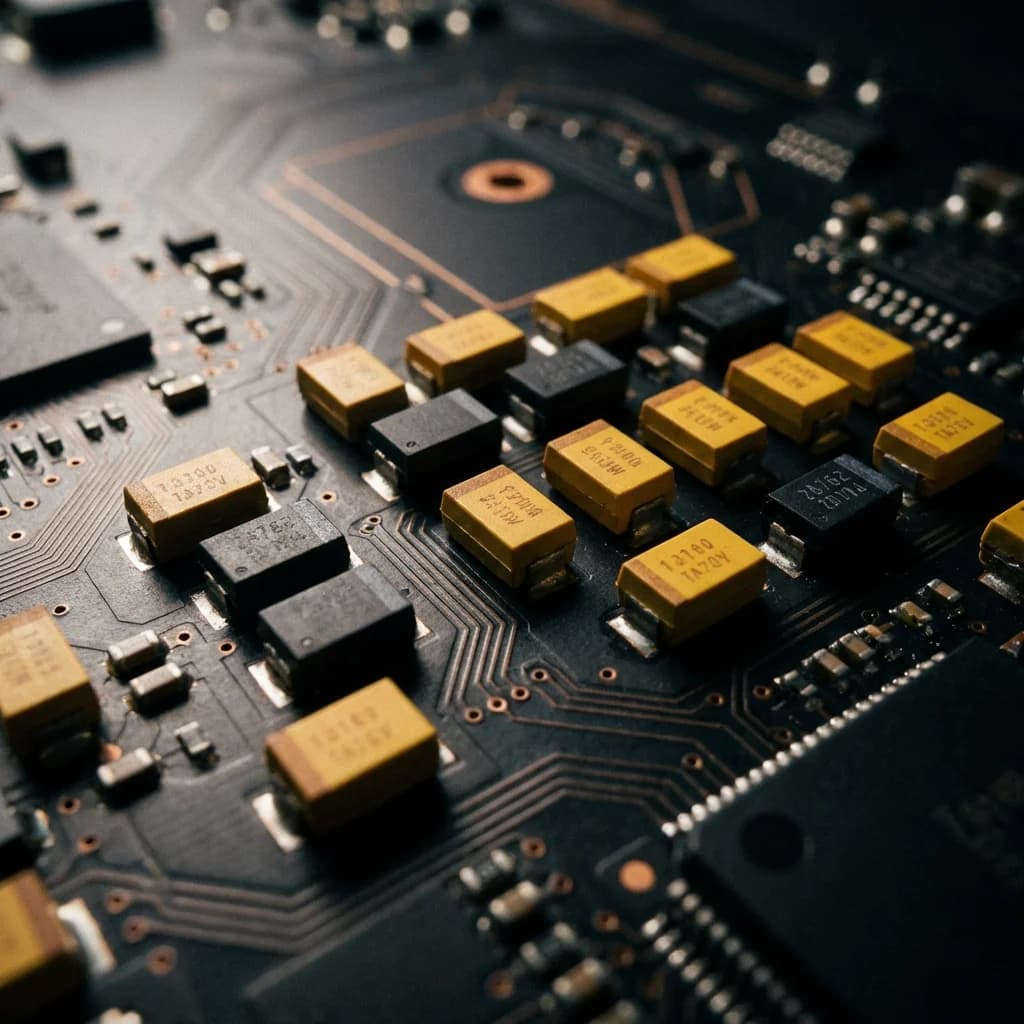
Tantalum Capacitors
Premium Component Solutions
High volumetric efficiency capacitors for space-constrained applications in military, aerospace, medical, and portable electronics.
Typical Specifications
Common Applications
Selection Tips
Capacitor Calculators
Use our free calculators to help with your tantalum capacitors capacitor selection and circuit design
Understanding Tantalum Capacitors
Tantalum capacitors offer the highest volumetric efficiency of common capacitor types, packing more capacitance into less space than alternatives. This makes them valuable in portable electronics, aerospace, and medical devices where space is at a premium.
Construction Technology
Tantalum capacitors use tantalum metal as the anode, with a thin tantalum pentoxide (Ta2O5) dielectric layer formed electrochemically. The cathode is either manganese dioxide (MnO2) or conductive polymer.
Sintered Anode: Tantalum powder is pressed and sintered into a porous pellet, creating enormous surface area in a small volume. This surface area determines capacitance.
Types by Cathode Material
MnO2 (Manganese Dioxide): Traditional construction offering good temperature range and reliability when properly applied. Can fail short-circuit under certain fault conditions.
Polymer: Conductive polymer cathode provides lower ESR, higher ripple current capability, and more benign failure mode. The polymer forms a self-limiting fault response rather than short-circuit.
Wet Tantalum: Liquid electrolyte cathode achieves the highest capacitance values for military and aerospace applications. Hermetically sealed for reliability.
Key Characteristics
Volumetric Efficiency: Tantalum capacitors achieve the highest capacitance per unit volume among standard capacitor types, essential for miniature electronics.
Polarity: Tantalum capacitors are polarized - reverse voltage causes irreversible damage and potential failure.
Derating: Tantalum capacitors should be derated 50% for voltage in standard applications, 60-70% in high-reliability applications. Voltage derating dramatically improves reliability.
Failure Mode: MnO2 tantalum capacitors can fail short-circuit, potentially causing circuit damage. Polymer types have self-limiting failure characteristics.
Tantalum Capacitors for Aerospace and Defense
Tantalum capacitors have been a cornerstone of aerospace and military electronics for decades. Their combination of high volumetric efficiency, wide temperature range, and proven reliability under extreme conditions makes them the default choice for many space, aviation, and defense applications.
MIL-PRF-55681 (Solid Tantalum): This military performance specification covers solid electrolyte tantalum capacitors, including both MnO2 and polymer cathode types. MIL-PRF-55681 defines qualification levels, screening requirements, and reliability grades. Failure Rate Level designations (M, P, R, S) indicate tested reliability, with S-level representing the highest reliability — typically required for flight-critical and mission-critical applications. Specap stocks MIL-PRF-55681 qualified tantalum capacitors and can source specific reliability levels and date codes for [aerospace programs](/applications/aerospace).
MIL-PRF-39003 (Established Reliability Solid Tantalum): This specification covers established reliability (ER) solid tantalum capacitors with controlled failure rate levels. ER components undergo periodic qualification testing to maintain their failure rate designations, providing confidence in ongoing reliability performance.
MIL-PRF-123 (Hermetically Sealed Wet Tantalum): Wet tantalum capacitors sealed in hermetic metal cases represent the highest reliability tier of tantalum technology. MIL-PRF-123 parts achieve capacitance-voltage (CV) products that solid tantalum cannot match, because the liquid electrolyte cathode conforms perfectly to the porous anode structure. Wet tantalum capacitors are standard in satellite power buses, missile guidance systems, strategic communications, and other applications where replacement is impossible and failure is not an option. Their hermetic seal prevents moisture ingress and electrolyte loss, enabling decades-long operational life.
Radiation Tolerance: Tantalum capacitors exhibit inherent tolerance to ionizing radiation, making them suitable for space and nuclear environments. While not immune to radiation effects, tantalum capacitors withstand total ionizing doses that would destroy many other capacitor technologies. Radiation-hardened grades with specified total dose tolerance are available for the most demanding space applications.
Temperature Extremes: Military and aerospace environments routinely expose capacitors to temperature extremes from -55C to +125C or even +175C for some automotive and downhole applications. Tantalum capacitors maintain usable capacitance and ESR across this range, though designers must account for capacitance variation with temperature (typically +/- 15% over the full military temperature range for MnO2 types).
Tantalum Capacitors for Medical Devices
Medical electronics demand the highest reliability from every component. Tantalum capacitors meet these demands through their stable, predictable electrical characteristics and proven long-term reliability in life-critical applications.
Implantable Medical Devices: Cardiac pacemakers, implantable cardioverter-defibrillators (ICDs), neurostimulators, cochlear implants, and drug delivery pumps all use tantalum capacitors. For these applications, the capacitor must function reliably for 10-15 years inside the human body at 37C with zero possibility of field replacement. Wet tantalum capacitors in hermetically sealed cases are the standard choice for implantable power supply filtering and timing circuits, where their volumetric efficiency minimizes implant size and their proven reliability supports the required device lifetimes.
For implantable defibrillators, specialized high-energy tantalum capacitors store the electrical energy delivered during defibrillation therapy. These capacitors charge to high voltages (up to 800V for some designs) and deliver the stored energy in a controlled waveform. The capacitor's energy density directly affects the device size, which is a critical factor for patient comfort and surgical placement options.
Diagnostic and Therapeutic Equipment: CT scanners, MRI systems, patient monitors, infusion pumps, ventilators, and surgical instruments use tantalum capacitors in power supplies, signal conditioning, and timing circuits. While these are not implanted, they still require high-reliability components because equipment failure can endanger patients. [Medical device manufacturers](/applications/medical) frequently specify tantalum capacitors for critical circuits even when alternative technologies could meet the basic electrical requirements, because the tantalum reliability data establishes the statistical confidence needed for FDA submission and regulatory compliance.
Medical Device Supply Chain: Medical OEMs maintain strict component qualification processes. Once a specific tantalum capacitor part number is qualified in a device design, changing to an alternative requires requalification — a process that can take months and cost tens of thousands of dollars. This creates strong demand for continuity of supply for specific part numbers, sometimes extending decades after the part was first qualified. Specap specializes in maintaining availability of qualified tantalum capacitor part numbers for medical device production lines.
Polymer vs MnO2 Tantalum: Detailed Comparison
The choice between polymer and manganese dioxide (MnO2) cathode tantalum capacitors affects performance, reliability, and cost. Understanding the detailed differences enables optimal selection for each application.
ESR Performance: Polymer tantalum capacitors achieve ESR values 10-50 times lower than equivalent MnO2 types. A typical 100uF/10V MnO2 tantalum might have 1-3 ohms ESR, while a polymer equivalent achieves 10-50 milliohms. This dramatic ESR reduction translates directly to higher ripple current capability, lower power dissipation, and reduced output voltage ripple in power supply applications. For high-frequency decoupling and processor power delivery, polymer tantalum is the clear choice when ESR is a driving parameter.
Failure Mode: This is perhaps the most significant difference. MnO2 tantalum capacitors can experience thermal runaway: a dielectric fault allows current flow through the MnO2, which is an oxidizer. The resulting exothermic reaction can produce localized temperatures exceeding 1500C, causing catastrophic short-circuit failure. Polymer tantalum capacitors have a fundamentally different failure response. When a dielectric fault occurs, the conductive polymer surrounding the fault site decomposes, becoming an insulator. This self-limiting mechanism converts the fault to a localized open circuit rather than a short circuit. The result is a graceful degradation — slight capacitance loss — rather than catastrophic failure.
Voltage Derating: Because of the different failure modes, derating recommendations differ. MnO2 tantalum capacitors require aggressive voltage derating — 50% for commercial applications, 60-70% for military and high-reliability. Polymer tantalum capacitors, with their self-limiting failure mode, may be used with less aggressive derating (typically 20-30%), although more conservative derating still improves long-term reliability. The reduced derating requirement means polymer tantalum capacitors provide more usable capacitance for a given rated voltage, partially offsetting their higher per-unit cost.
Temperature Range: MnO2 tantalum capacitors operate across the full military temperature range (-55C to +125C) and some grades extend to +175C. Polymer tantalum capacitors have historically been limited to +105C or +125C maximum because the conductive polymer cathode degrades at elevated temperatures. This temperature limitation has been improving with newer polymer formulations, but for extreme-temperature applications (downhole drilling, aerospace, military), MnO2 remains the default choice.
Capacitance Stability: Both types offer good capacitance stability with temperature and aging, significantly better than Class 2 ceramic capacitors. MnO2 types show slightly better stability at temperature extremes. Both types are polarized and exhibit no DC bias effect (unlike ceramic capacitors, which lose capacitance under applied voltage).
Cost Considerations: Polymer tantalum capacitors carry a price premium over MnO2 types, typically 30-100% more for equivalent CV ratings. However, the total cost comparison must account for the reduced derating (allowing use of lower-voltage-rated, smaller, cheaper parts), elimination of external protection circuitry that MnO2 failure modes may require, and the higher ripple current rating that may reduce the number of parallel capacitors needed.
Sourcing Obsolete Tantalum Capacitors
Tantalum capacitor obsolescence creates serious challenges for aerospace, defense, and medical device programs where component qualification cycles are measured in years and specific part numbers are locked into approved vendor lists and device master records.
Why Tantalum Capacitors Go Obsolete: Manufacturers regularly rationalize their tantalum capacitor portfolios, discontinuing low-volume part numbers, older case sizes, and specifications that no longer align with market demand. Mergers and acquisitions in the capacitor industry (Vishay acquiring Sprague, KEMET merging with Yageo, AVX being acquired by Kyocera) have triggered multiple waves of product discontinuation as combined product lines are streamlined.
Impact on Long-Lifecycle Programs: Military platforms, commercial aircraft, and medical devices can remain in production and service for 20-30 years or longer. The tantalum capacitors qualified during original design may be discontinued long before the end-of-life of the system. When this happens, the program faces a choice between an expensive requalification with a new part, a lifetime buy of the obsolete part (if available), or sourcing the obsolete part from specialty distributors.
Specap Obsolete Tantalum Sourcing: Specap maintains one of the largest inventories of obsolete and hard-to-find tantalum capacitors in the United States. Our inventory includes discontinued part numbers from Sprague, Kemet, AVX, Vishay, and other manufacturers spanning decades of production. For [obsolete capacitor requirements](/obsolete-capacitors), we provide full traceability, date code information, and testing as required. Whether you need MIL-qualified wet tantalum capacitors for a legacy defense program or discontinued surface-mount tantalum for a medical device production line, Specap can help maintain your supply chain.
Cross-Reference and Alternate Sourcing: When exact part numbers are unavailable, Specap provides detailed cross-reference analysis to identify form-fit-function replacements from current production. Our engineering team evaluates electrical parameters, physical dimensions, qualification status, and reliability data to ensure the replacement meets the original design intent. For military and medical applications, we document the cross-reference rationale to support customer qualification and regulatory submissions.
Tantalum Capacitors in Portable and Consumer Electronics
While aerospace and medical represent the highest-reliability tantalum applications, portable consumer electronics consume the majority of tantalum capacitor volume. Smartphones, tablets, laptops, wearables, and IoT devices leverage tantalum's volumetric efficiency to minimize board space in battery-powered designs.
Processor and SoC Decoupling: Modern mobile processors require bulk decoupling capacitance close to the power pins to support rapid current transients during clock frequency changes and burst processing. Polymer tantalum capacitors provide stable, predictable capacitance that does not degrade under DC bias — unlike Class 2 ceramic capacitors, which can lose 50-80% of their rated capacitance at operating voltage. This predictable capacitance makes tantalum capacitors valuable for critical power rail decoupling where minimum capacitance must be guaranteed.
Battery-Powered Design Considerations: In battery-powered devices, the supply voltage varies as the battery discharges. Tantalum capacitors maintain stable capacitance across the full battery voltage range, simplifying power integrity analysis. Their low leakage current (typically microamps at rated voltage) minimizes parasitic battery drain in low-power sleep modes, which is critical for IoT sensors and wearable devices designed to operate for months or years on a single battery.
Tantalum vs MLCC in Consumer Applications: For many consumer electronics applications, high-capacitance MLCCs (10uF-100uF in X5R or X7R dielectric) have replaced tantalum capacitors. MLCCs are lower cost and available in smaller packages. However, tantalum retains advantages where guaranteed minimum capacitance is needed (no DC bias derating), where supply voltage is close to the capacitor's rated voltage, and where the design cannot accommodate the larger MLCC footprint needed to compensate for DC bias losses.
Tantalum Capacitor Testing and Incoming Inspection
Given the critical nature of most tantalum capacitor applications, incoming inspection and testing protocols are particularly important. This is especially true for obsolete or long-stored tantalum capacitors where storage conditions may be uncertain.
Capacitance and Dissipation Factor: Standard capacitance measurement at 120Hz and rated dissipation factor testing confirm the capacitor meets its datasheet specifications. For aged or stored parts, comparison against original specifications verifies that no significant degradation has occurred.
DC Leakage Current: Leakage current measurement at rated voltage after a stabilization period (typically 5 minutes) is the most sensitive indicator of tantalum capacitor health. Elevated leakage current can indicate dielectric damage, contamination, or degradation. MIL-PRF-55681 specifies maximum leakage current limits by CV product and voltage rating.
Surge Current Testing: For parts destined for applications with inrush current exposure, surge testing per applicable military or manufacturer specifications verifies the capacitor can withstand the repetitive current spikes it will experience in service. Surge testing is destructive for marginal parts and should be performed on sample quantities rather than 100% of incoming parts.
Visual and Mechanical Inspection: External inspection for cracks, chips, terminal damage, marking legibility, and proper packaging protects against handling damage during storage and shipping. For hermetically sealed wet tantalum capacitors, hermeticity testing (fine and gross leak per MIL-STD-883) verifies seal integrity. Specap performs incoming inspection on all [obsolete capacitor](/obsolete-capacitors) inventory to ensure that parts shipped to customers meet original manufacturer specifications.
Voltage derating is critical for tantalum capacitor reliability — see our <a href="/resources/guides/capacitor-derating">Capacitor Derating Guide</a> for detailed derating curves and best practices. For a comparison of tantalum against other capacitor technologies, consult our <a href="/resources/guides/capacitor-types">Capacitor Types Guide</a>. Engineers working with tantalum capacitors in [medical devices](/applications/medical) or [aerospace systems](/applications/aerospace) should review the relevant application pages for compliance guidance.
Tantalum Capacitors FAQs
Common questions about this capacitor type
Request a Quote
Get competitive pricing tailored to your specific requirements.
Need a Substitute?
Our engineers cross-reference specs to find compatible alternates that meet or exceed your original part.
Find AlternatesObsolete Part?
We specialize in sourcing discontinued and hard-to-find capacitors with full traceability documentation.
Source Obsolete PartBulk Buy?
Volume pricing with same-day quotes. We stock large quantities and offer blanket order programs.
Get Bulk PricingRelated Resources
Explore our technical resources to learn more about tantalum capacitors capacitors and make better selection decisions.
Capacitor Types Guide
Compare all capacitor technologies and their ideal use cases
Derating Guide
Voltage and temperature derating best practices for reliability
Capacitor Glossary
Definitions for ESR, ripple current, dielectric, and 50+ terms
Cross-Reference Tool
Find equivalent replacements for obsolete or discontinued parts
Explore Related Topics
Related Categories
Common Applications
Need Help Selecting Tantalum Capacitors?
Our expert team has decades of experience helping customers find the right capacitors. Contact us for technical guidance or custom quotes.