
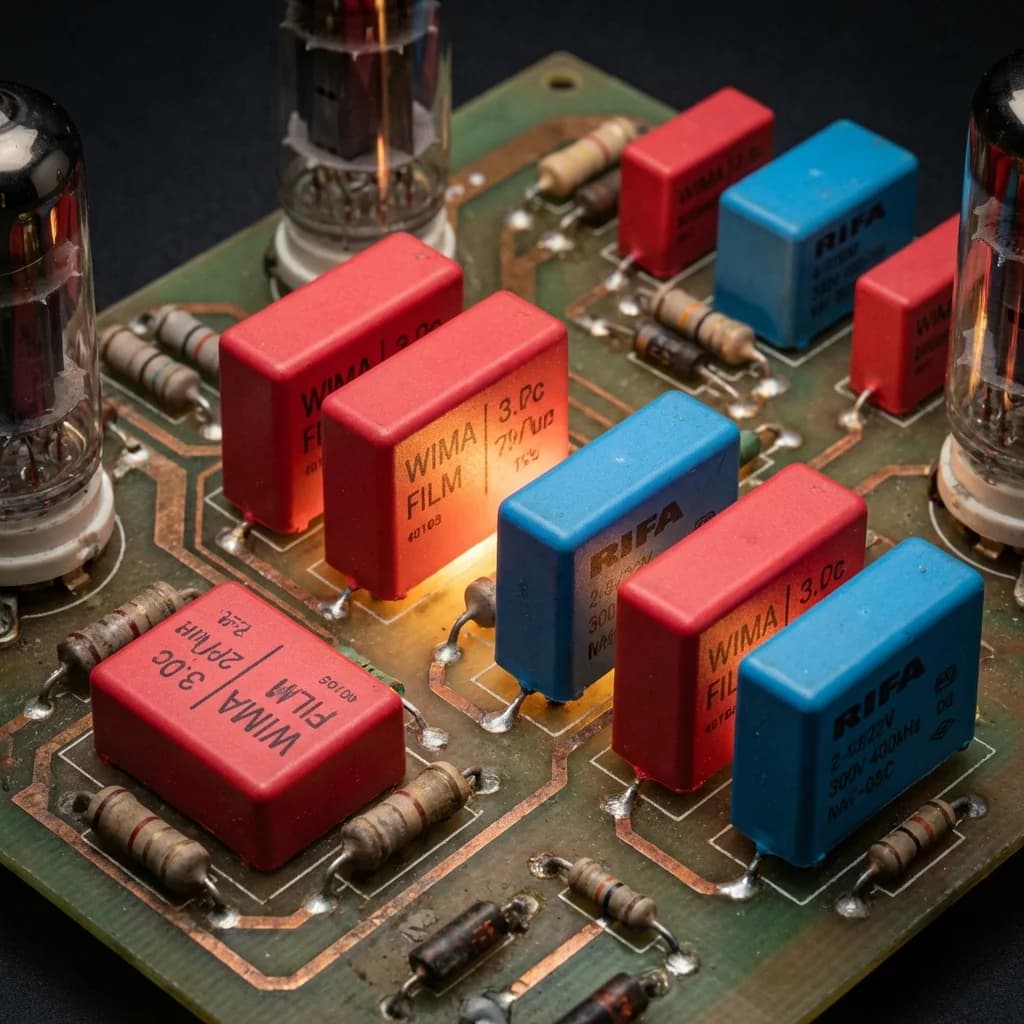
Film Capacitors
Premium Component Solutions
Buy film capacitors — polyester, polypropylene & AC rated. 50V-30kV. Self-healing, low loss, precision tolerance. In stock for power electronics, audio, motor drives & HVAC. Same-day shipping from Specap.
Typical Specifications
Common Applications
Selection Tips
Capacitor Calculators
Use our free calculators to help with your film capacitors capacitor selection and circuit design
Understanding Film Capacitors
Film capacitors use thin plastic films as the dielectric, offering excellent electrical characteristics including low losses, high insulation resistance, and long-term stability. They are essential components in power electronics, audio equipment, and precision circuits.
Film Dielectric Types
Polypropylene (PP/MKP): Lowest losses, highest stability, excellent for AC and pulse applications. Preferred for audio and high-frequency power electronics.
Polyester (PET/MKT): Higher capacitance density than PP, good general-purpose choice. Slightly higher losses limit high-frequency use.
Polyphenylene Sulfide (PPS): Excellent temperature stability, suitable for automotive and high-reliability applications.
Polyethylene Naphthalate (PEN): Good temperature and humidity resistance, used in demanding environments.
Construction Types
Metallized Film: Thin metal layer deposited on film provides self-healing capability - local breakdowns vaporize the metallization, isolating the fault. Compact construction but lower current handling.
Film-Foil: Separate metal foils provide lower ESR and higher current capability but no self-healing. Larger than metallized for same capacitance.
Key Characteristics
Self-Healing: Metallized film capacitors can survive dielectric defects through localized vaporization of the metallization. This improves reliability in many applications.
Low ESR and ESL: Film construction provides very low equivalent series resistance and inductance, making film capacitors excellent for high-frequency applications.
No Aging: Unlike electrolytic capacitors, film capacitors show no significant degradation over time under normal conditions. This makes them ideal for [audio applications](/applications/audio) where long-term sonic consistency is valued.
AC Capability: Film capacitors handle AC voltage and current without the limitations of polarized types. Film capacitors are the standard for [motor run applications](/capacitors/motor) and power factor correction.
Film Capacitors for Power Electronics
Power electronics is the fastest-growing application area for film capacitors. As power conversion equipment increases in switching frequency and power density, the demands on DC link capacitors, snubber capacitors, and filter capacitors continue to intensify.
DC Link Capacitors: In voltage-source inverters and converters, DC link capacitors store energy on the DC bus and decouple the rectifier from the inverter. Film DC link capacitors — typically polypropylene — are increasingly replacing electrolytic capacitors in this role because they handle far higher ripple currents relative to their size, do not wear out from electrolyte evaporation, and tolerate voltage reversals. DC link film capacitors are available in dry and oil-filled constructions, with capacitance values from a few microfarads to several millifarads at voltages up to 3000V or more.
For [power electronics applications](/applications/power-electronics), key DC link capacitor parameters include rated voltage (DC and peak AC), RMS current at switching frequency, ESR and ESL at operating frequency, dv/dt capability, and self-healing reliability. Specap stocks DC link film capacitors from major manufacturers including KEMET, Vishay, TDK/EPCOS, and Cornell Dubilier.
Snubber Capacitors: Snubber circuits protect power semiconductors by limiting voltage transients during switching. Snubber capacitors must absorb high-energy pulses with extremely fast rise times, demanding very low ESL and ESR. Polypropylene film capacitors in either metallized or film-foil construction are the standard choice. Film-foil types handle higher peak currents, while metallized types offer self-healing capability in case of voltage overshoot. Critical snubber capacitor parameters include dv/dt rating (often 1000 V/us or more), peak current capability, ESL, and pulse handling energy.
EMI Filtering: Film capacitors are essential components in EMI/RFI filters for power electronics. X-class (line-to-line) and Y-class (line-to-ground) safety-rated film capacitors suppress conducted electromagnetic interference at the power input. These capacitors must be safety-agency approved (UL, CSA, VDE, ENEC) because their failure mode in line-connected applications has safety implications. X2-rated metallized polypropylene capacitors are the most common type, offering self-healing operation and reliable EMI suppression in switching power supplies, motor drives, and industrial controls.
Film Capacitors for Audio Applications
Audio engineers and designers prize film capacitors for their linear dielectric behavior, absence of microphonics, and long-term stability. In high-performance audio equipment, film capacitor selection can measurably impact distortion, frequency response, and noise floor.
Crossover Networks: Passive loudspeaker crossover networks are the single largest application for film capacitors in audio. The capacitors in a crossover filter determine the frequency division between drivers, and their characteristics directly affect the acoustic output. Polypropylene (MKP) capacitors are the standard choice for crossover networks because of their low dielectric absorption, low losses, and stable capacitance over the audio frequency range. Values typically range from 1uF to 100uF, and tight tolerances (2-5%) ensure consistent crossover points between production speakers.
Coupling and Signal Path: In preamplifiers, amplifiers, and digital-to-analog converters, film capacitors block DC while passing audio signals between stages. The capacitor's dielectric absorption, ESR, and nonlinearity all affect the audio signal. Polypropylene and polystyrene types have the lowest dielectric absorption, making them preferred for critical signal path positions. Polyester (MKT) types are acceptable for less critical coupling applications where some additional loss is tolerable.
Bypass and Decoupling: Film bypass capacitors in audio circuits provide local energy storage for op-amps and gain stages. While ceramic capacitors are commonly used for high-frequency bypass, film capacitors avoid the piezoelectric microphonic effects of ceramic dielectrics — an important consideration in phono stages, microphone preamps, and other high-gain circuits where vibration-induced noise is a concern.
For high-end audio applications, Specap provides film capacitors from specialty audio-grade manufacturers as well as premium industrial types that audio designers frequently specify, including the [audio applications](/applications/audio) page for detailed specifications and stocking information.
Film Capacitors for Motor Applications
Film capacitors are the foundation of single-phase motor operation. Motor run capacitors, power factor correction capacitors, and phase-shifting capacitors are all film types, predominantly metallized polypropylene in oil-filled or dry construction.
Motor Run Capacitors: Oil-filled metallized polypropylene motor run capacitors provide continuous-duty AC operation in [motor applications](/capacitors/motor). The polypropylene dielectric provides self-healing capability, so minor dielectric defects are cleared without catastrophic failure. Oil filling improves heat dissipation and increases the voltage withstand capability. Motor run capacitors are rated for continuous AC operation at 50/60Hz with life expectations of 10-20 years. For HVAC motor capacitor needs, see our dedicated [HVAC applications page](/applications/hvac).
Power Factor Correction (PFC): Capacitor banks for power factor correction use large film capacitors to offset the reactive power drawn by inductive loads — primarily motors and transformers. PFC capacitors operate continuously at AC line voltage and must handle substantial reactive current without overheating. Three-phase PFC capacitors use metallized polypropylene construction rated for 15,000-30,000 hours at full load. They include built-in discharge resistors to safely reduce the terminal voltage after disconnection.
Phase-Shifting and Conversion: In applications where three-phase motors must operate from single-phase power, film capacitors create the necessary phase shift to approximate a rotating magnetic field. These capacitors are subjected to continuous AC stress and must be rated for the full motor voltage and current. Undersized or incorrectly rated capacitors will overheat and fail prematurely.
How to Select a Film Capacitor
Choosing the optimal film capacitor requires matching the dielectric type, construction, and ratings to the application requirements. Here is a systematic approach:
**Step 1 — Identify the dielectric.** Polypropylene (PP/MKP) for lowest loss, highest stability, and AC/pulse applications. Polyester (PET/MKT) for general-purpose DC filtering and coupling where higher capacitance density is needed. PPS or PEN for demanding temperature or humidity environments.
**Step 2 — Choose construction type.** Metallized film for self-healing, compact size, and moderate current. Film-foil for lowest ESR, highest peak current, and applications where self-healing is not needed. Hybrid designs combine metallized sections with foil end connections for improved current handling.
**Step 3 — Determine voltage requirements.** For DC applications, select a voltage rating at least 10-20% above the maximum DC plus any AC component. For AC applications, verify the capacitor is rated for the full AC voltage at line frequency. For pulse applications, confirm the dv/dt rating meets the circuit requirements.
**Step 4 — Evaluate current and power dissipation.** Calculate the RMS current at all operating frequencies. Verify that the capacitor's rated current exceeds the application current at each frequency. The total power dissipated in the capacitor must not exceed the thermal rating, accounting for ambient temperature and cooling conditions.
**Step 5 — Check frequency response.** Verify that the capacitor's impedance at the operating frequency meets the circuit requirements. Self-inductance (ESL) limits high-frequency performance — smaller capacitors and those with special lead configurations (such as four-terminal or low-inductance mounting) provide lower ESL.
**Step 6 — Consider environmental factors.** Operating temperature range, humidity, altitude, and vibration all affect capacitor selection. For outdoor or harsh environments, sealed or potted constructions provide better protection. For high-humidity environments, PEN or PPS dielectrics may outperform polypropylene.
When replacing film capacitors in legacy equipment or specifying alternatives for discontinued parts, Specap provides cross-reference assistance and maintains stock of both current production and hard-to-find film capacitor values. See our <a href="/resources/guides/film-capacitor-selection">Film Capacitor Selection Guide</a> for detailed application recommendations.
Film Capacitor Reliability and Life Expectancy
One of the most compelling advantages of film capacitors is their exceptional reliability and predictable long-term performance. Unlike electrolytic capacitors, which have a defined wear-out mechanism (electrolyte evaporation), film capacitors do not degrade significantly under normal operating conditions.
No Electrolyte to Dry Out: Film capacitors use solid or metallized dielectric with no liquid components. There is no evaporation mechanism and no chemical degradation pathway under normal operating conditions. A properly applied film capacitor will maintain its capacitance, ESR, and insulation resistance for decades.
Self-Healing Extends Service Life: In metallized film capacitors, the self-healing mechanism clears minor dielectric defects that would cause permanent failure in other capacitor technologies. Each self-healing event reduces capacitance by a tiny fraction of a percent, but the cumulative effect over the capacitor's life is negligible. This means metallized film capacitors actually become more reliable over time as weak spots are progressively cleared.
Failure Modes in Film Capacitors: When film capacitors do fail, the most common causes are thermal overload (excessive ripple current or ambient temperature), voltage overstress (exceeding the rated voltage or dv/dt), and humidity ingress (in unsealed constructions exposed to moisture). In metallized types, extreme overstress can exhaust the self-healing capability, causing eventual short-circuit. In properly derated applications, film capacitor failure rates are among the lowest of any passive component technology.
Life Calculation: Unlike electrolytic capacitors where life can be calculated from temperature and ripple current, film capacitor life is primarily limited by voltage stress and temperature. Manufacturers provide voltage-life and temperature-life curves that allow designers to estimate expected service life at the actual operating conditions. At typical derating levels (80% of rated voltage, ambient temperature below maximum rating), film capacitor life often exceeds 100,000 hours — well beyond the service life of most equipment.
Film Capacitors in Renewable Energy
The global expansion of solar inverters, wind turbine converters, and energy storage systems has created enormous demand for high-reliability film capacitors. These applications combine high power levels, continuous operation, and demanding environmental conditions.
Solar Inverters: String and central solar inverters use DC link film capacitors on the PV input bus and AC filter capacitors on the grid-connected output. The DC link capacitors must handle the DC voltage from the PV string (up to 1500V in modern systems) plus switching-frequency ripple current. Film capacitors are preferred over electrolytic in solar inverters because the 20-25 year expected service life of the inverter exceeds the practical life of electrolytic capacitors. Polypropylene DC link capacitors rated for 20,000+ hours at full load are standard in quality solar inverters.
Wind Turbine Converters: Full-scale power converters in modern wind turbines use large film capacitor banks for DC link energy storage. The capacitors must withstand continuous vibration from the turbine nacelle, wide temperature swings, and high ripple currents from the converter switching. Film capacitors' tolerance for vibration, temperature cycling, and lack of wear-out mechanism make them the natural choice for this demanding application, supporting the [power electronics](/applications/power-electronics) that are essential to renewable energy generation.
Energy Storage Systems (ESS): Grid-scale battery energy storage systems and residential battery inverters use film capacitors in the DC-AC conversion stages. These systems must operate continuously for 20+ years with minimal maintenance, making film capacitors' long service life a critical design advantage. The high ripple current handling of film DC link capacitors reduces the number of parallel capacitors needed, lowering system cost and improving power density.
Film Capacitors for HVAC and Refrigeration
Beyond motor run applications, film capacitors serve additional roles in [HVAC systems](/applications/hvac) and commercial refrigeration equipment. Compressor inverters in variable-speed air conditioners and heat pumps use DC link film capacitors similar to those in industrial motor drives. EMI filters at the power input of HVAC controllers use X2-rated film capacitors for line-to-line filtering and Y2-rated film capacitors for line-to-ground protection. These safety-rated capacitors must carry the appropriate agency approvals (UL, CSA, VDE) for the target market. Additionally, lighting ballasts for commercial buildings use film capacitors for power factor correction and high-frequency filtering, with polypropylene types preferred for their low losses and long life in continuously operating fixtures.
Film Capacitors FAQs
Common questions about this capacitor type
Request a Quote
Get competitive pricing tailored to your specific requirements.
Need a Substitute?
Our engineers cross-reference specs to find compatible alternates that meet or exceed your original part.
Find AlternatesObsolete Part?
We specialize in sourcing discontinued and hard-to-find capacitors with full traceability documentation.
Source Obsolete PartBulk Buy?
Volume pricing with same-day quotes. We stock large quantities and offer blanket order programs.
Get Bulk PricingRelated Resources
Explore our technical resources to learn more about film capacitors capacitors and make better selection decisions.
Capacitor Types Guide
Compare all capacitor technologies and their ideal use cases
Derating Guide
Voltage and temperature derating best practices for reliability
Capacitor Glossary
Definitions for ESR, ripple current, dielectric, and 50+ terms
Cross-Reference Tool
Find equivalent replacements for obsolete or discontinued parts
Explore Related Topics
Related Categories
Need Help Selecting Film Capacitors?
Our expert team has decades of experience helping customers find the right capacitors. Contact us for technical guidance or custom quotes.