
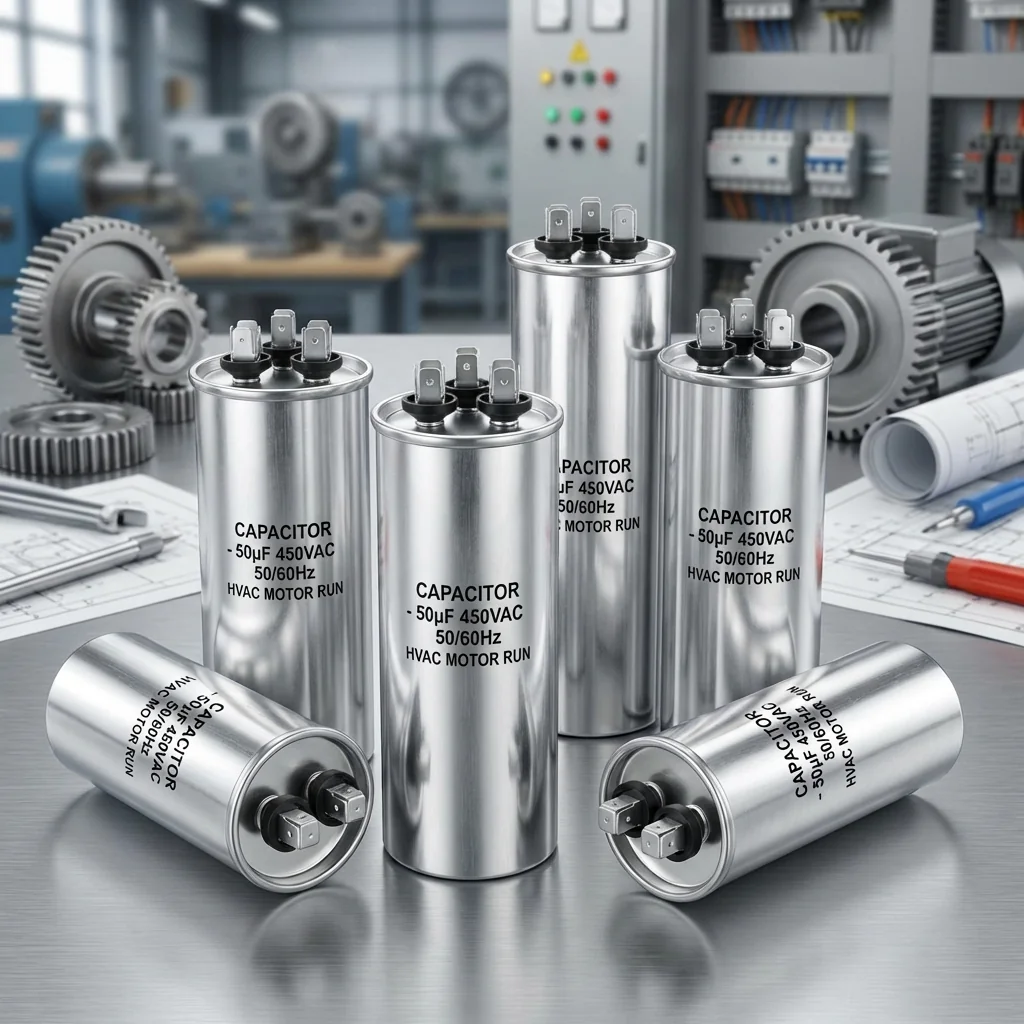
Motor Capacitors
Premium Component Solutions
Buy motor capacitors — motor start, motor run & dual-run capacitors for HVAC, compressors, pumps & industrial motors. 110V-660V AC. In stock, same-day shipping from Specap.
Typical Specifications
Common Applications
Selection Tips
Capacitor Calculators
Use our free calculators to help with your motor capacitors capacitor selection and circuit design
Understanding Motor Capacitors
Motor capacitors enable single-phase AC motors to start and run efficiently. Without a capacitor, single-phase motors cannot develop starting torque or run efficiently because they lack the rotating magnetic field that three-phase motors produce naturally. Motor capacitors are essential components in HVAC systems, refrigeration equipment, pool pumps, well pumps, industrial fans, and countless other applications where single-phase motors are used.
Specap stocks thousands of motor capacitors in all common and hard-to-find values. Whether you need a standard HVAC capacitor for a residential air conditioner or an obsolete motor capacitor for legacy industrial equipment, we have you covered with same-day shipping and free technical support.
Motor Run Capacitors
Run capacitors remain in the circuit during motor operation. They create phase shift in the auxiliary winding, producing the rotating magnetic field needed for smooth operation.
Construction: Oil-filled metallized polypropylene film provides long life in continuous duty. The oil improves heat dissipation and increases dielectric strength. Quality motor run capacitors last 10-20 years under normal operating conditions.
Ratings: Specified in microfarads (µF) and AC voltage. Common ratings range from 2.5µF to 80µF at 370-440VAC. Using the correct value is critical — wrong capacitance affects motor efficiency, power factor, and service life.
Common Motor Run Capacitor Values: 5µF, 7.5µF, 10µF, 15µF, 20µF, 25µF, 30µF, 35µF, 40µF, 45µF, 50µF, 55µF, 60µF, 70µF, 80µF at 370VAC or 440VAC.
Motor Start Capacitors
Start capacitors provide the extra torque needed to start motors under load. They deliver high capacitance for a short duration (typically 3-5 seconds).
Construction: Aluminum electrolytic construction achieves high capacitance economically. Because they operate only briefly, they tolerate the heating that would damage them in continuous service.
Ratings: Values typically 50-500µF at 110-330VAC. Start capacitors are removed from the circuit by a centrifugal switch or potential relay once the motor reaches speed.
Hard Start Kits
Hard start kits combine a start capacitor with a relay to help compressors start under difficult conditions — low voltage, high head pressure, or weak compressors. They are a common solution for aging compressors that struggle to start on hot days.
Dual Run Capacitors
Dual run capacitors combine compressor and fan motor run capacitors in a single can, simplifying wiring and saving space in HVAC equipment. Common dual capacitor configurations include 35/5µF, 40/5µF, 45/5µF, 50/5µF, and 55/5µF at 370 or 440VAC.
Motor Capacitors for HVAC Systems
HVAC systems are the single largest application for motor capacitors. Air conditioning units, heat pumps, furnace blowers, and commercial refrigeration all depend on motor capacitors for reliable operation:
Residential Air Conditioning: Outdoor condensing units typically use a dual run capacitor (compressor + condenser fan) and sometimes a start capacitor for the compressor. Common compressor run values range from 30-60µF.
Commercial HVAC: Rooftop units, split systems, and chillers use larger motor capacitors, often with multiple compressors each requiring its own capacitor set.
Furnace Blower Motors: Indoor blower motors use run capacitors typically ranging from 5-15µF at 370VAC. PSC (Permanent Split Capacitor) motors require a run capacitor; ECM motors do not.
Refrigeration: Walk-in coolers, reach-in refrigerators, ice machines, and commercial freezers use motor capacitors for compressors and evaporator fan motors. Extended temperature range is important for freezer applications.
Motor Capacitors for Pumps
Pool and Spa Pumps: Pool pump motors typically use run capacitors ranging from 15-50µF depending on horsepower. Pump capacitors are exposed to outdoor environments and benefit from higher temperature ratings.
Well Pumps: Submersible well pump motors use start capacitors to overcome the high starting torque required by the impeller and water column. Deep well pumps may use dual-voltage capacitors.
Industrial Pumps: Irrigation pumps, sump pumps, and process pumps use motor capacitors sized for the specific motor horsepower and voltage.
Motor Capacitor Sizing Guide
To find the correct motor capacitor:
1. **Check the motor nameplate** — the required capacitor value (µF) and voltage are usually printed on the nameplate or data plate
2. **Check the old capacitor** — if the original capacitor is still available, the specifications are printed on the label
3. **Match capacitance exactly** — the µF value must match. Higher is NOT better for motors
4. **Voltage can be equal or higher** — a 440VAC capacitor works fine on a 370V system, but never use lower voltage than specified
5. **Match the physical size** — ensure the replacement fits in the mounting bracket or compartment
Troubleshooting Motor Capacitor Problems
Motor won't start, just hums: Usually indicates a failed start capacitor or run capacitor. Disconnect power, discharge the capacitor, and test with a capacitance meter.
Motor starts slowly or weakly: Start capacitor may have lost capacitance. Test and replace if more than 10% below rated value.
Motor runs hot or trips overload: Run capacitor may be failing. Incorrect capacitance causes imbalanced current draw and excessive heating.
Motor runs but with reduced power: Partial capacitor failure. The capacitor may still have some capacitance but not enough for proper operation.
Capacitor bulging or leaking: Replace immediately. Oil leakage from a run capacitor or electrolyte leakage from a start capacitor indicates end of life.
Need help diagnosing a motor capacitor issue? See our <a href="/resources/guides/motor-capacitor-troubleshooting">Motor Capacitor Troubleshooting Guide</a> for step-by-step testing procedures, sizing charts, and wiring diagrams.
If your motor capacitor has been discontinued or you need an exact replacement for legacy HVAC equipment, visit our [obsolete capacitor sourcing](/obsolete-capacitors) page or browse [Allen-Bradley capacitors](/brands/allen-bradley) for industrial motor drive replacements.
Motor Capacitors FAQs
Common questions about this capacitor type
Request a Quote
Get competitive pricing tailored to your specific requirements.
Need a Substitute?
Our engineers cross-reference specs to find compatible alternates that meet or exceed your original part.
Find AlternatesObsolete Part?
We specialize in sourcing discontinued and hard-to-find capacitors with full traceability documentation.
Source Obsolete PartBulk Buy?
Volume pricing with same-day quotes. We stock large quantities and offer blanket order programs.
Get Bulk PricingRelated Resources
Explore our technical resources to learn more about motor capacitors capacitors and make better selection decisions.
Capacitor Types Guide
Compare all capacitor technologies and their ideal use cases
Derating Guide
Voltage and temperature derating best practices for reliability
Capacitor Glossary
Definitions for ESR, ripple current, dielectric, and 50+ terms
Cross-Reference Tool
Find equivalent replacements for obsolete or discontinued parts
Explore Related Topics
Related Categories
Common Applications
Need Help Selecting Motor Capacitors?
Our expert team has decades of experience helping customers find the right capacitors. Contact us for technical guidance or custom quotes.